Mount St. Helens, WA
Saturday, 2 September, 2023
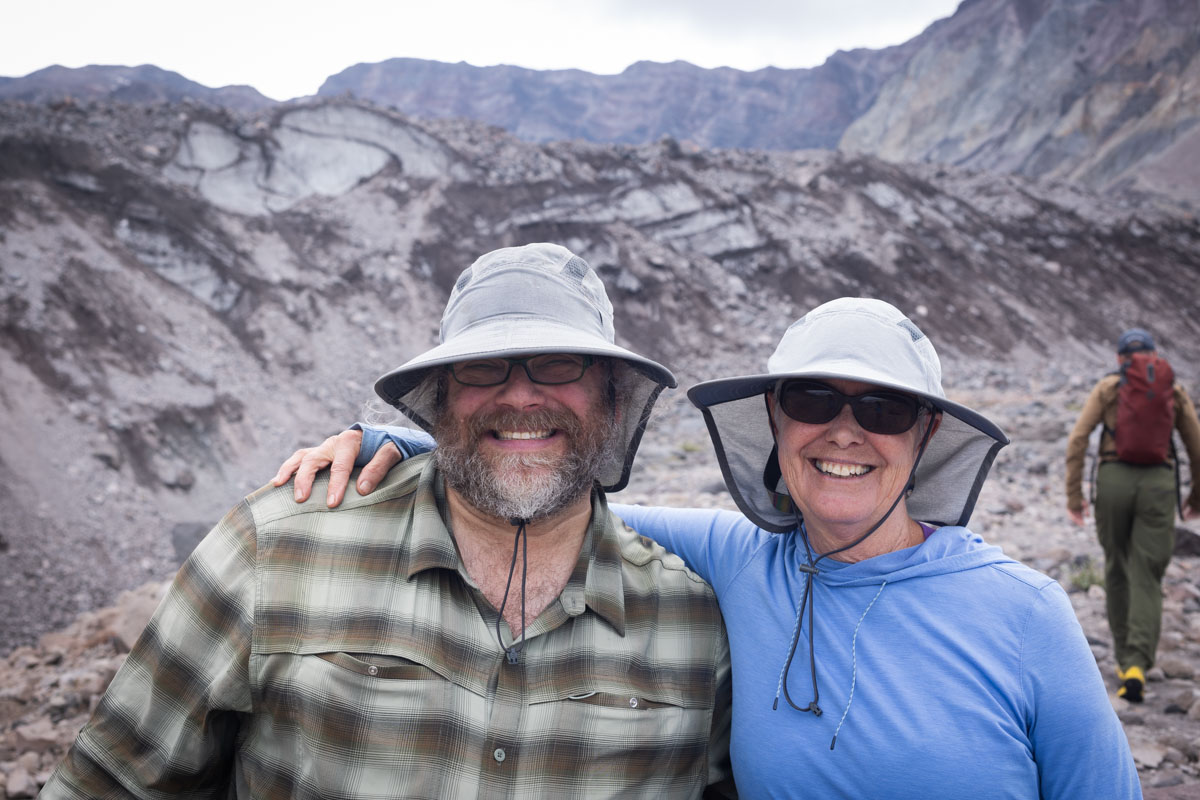
Us inside the crater! Photo by Dave.
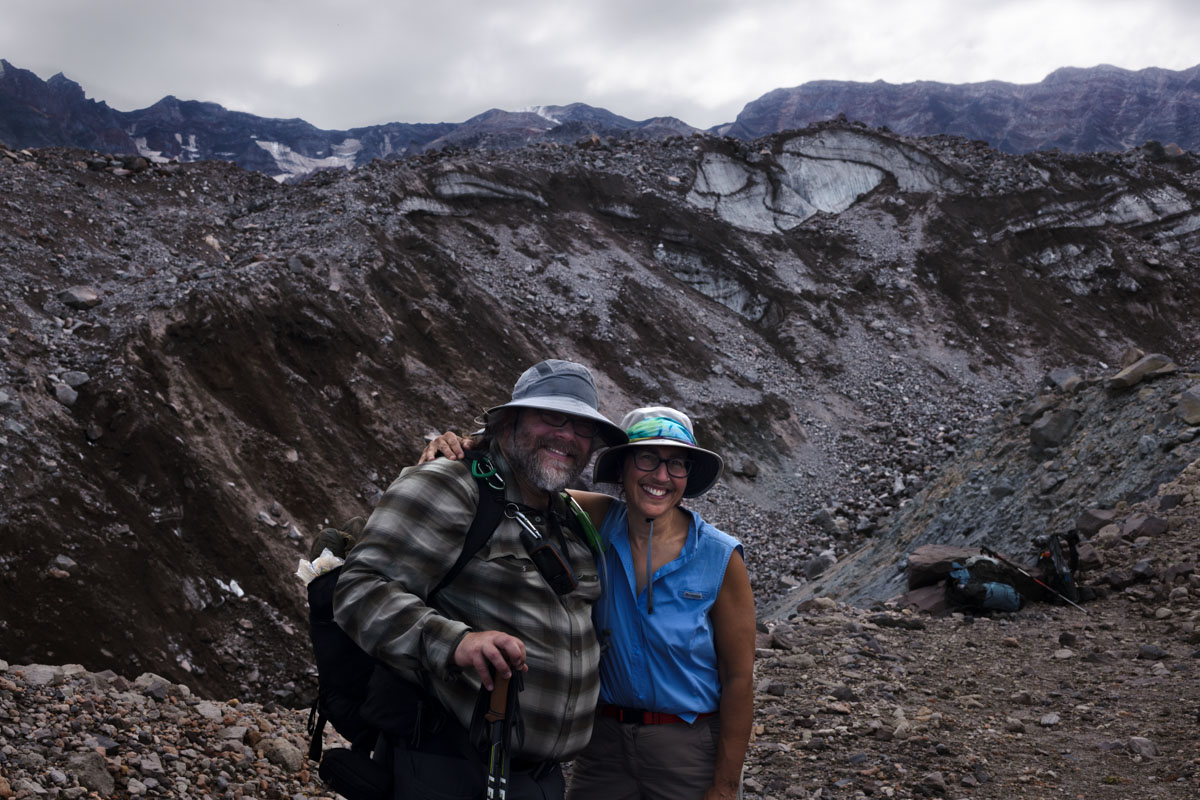
Our adventure on the Into the Crater trip with the Mount St. Helens Institute was one of our most incredible, in a lifetime of amazing exploration. I cannot describe the joy of seeing Eric, with the help of our guides, reach the top of the crater rim on his twisted ankle. The power and awe of looking the patterns of the inside of the mountain, seeing the shine of the glacier, and hearing the roar of the rockfalls, was astounding. We will never, ever forget our outstanding day on the edge of the crater.
We arrived at camp in apprehension. Gary, the trip leader, approached us with a clipboard containing the obligatory conflict waiver. I signed it, and Eric told Gary about his injury. Gary said that he ran trail races, and that he had been in this situation many times, where he was horrified to injure himself just before a race. He said that you never know what you can do until you try, and, since we knew the ankle wasn't broken, that he thought Eric should give it a shot.
We set up our camp with renewed hope in our hearts, and joined the group for a pasta dinner around propane firepits.
We met our insightful geology guides, Cynthia and Willie, both of whom had worked for the US Geological Survey. Willie had arrived at the mountain days after it erupted (after having been their earlier and been unable to stay) and observed the effects of the destruction. Cynthia had come later and done original research at the site, analyzing samples drilled from rocks and dating sections of the site based on the magnetic polarity of the samples. Cynthia and Willie were both now retired, but Willie said he thought he had one more hike into the crater in him.
We went around the circle introducing ourselves. Veronica, a student of recreation management from Ohio, would be assisting Gary in guiding us. They were further assisted by two volunteers, Dave, a big joker, and Saynier, another student. Also along with us from the Mount St. Helens Institute was a new office employee, Alyssa, who was going along on the tour to get a better look at the mountain. There were a few couples, and one family with a younger couple from Seattle who had brought along a set of parents from Maryland. We were heartened by the fact that we were in a lower age percentile among the participants.
Eric introduced himself, saying, "I'm here to make Willie look like Usain Bolt."
Willie and Cynthia gave a talk about the eruption, how difficult it was to understand the enormity of the destruction, and the human tragedy of lost lives. They told us that we were incredibly fortunate that it had happened on a beautiful, sunny day, so that many photographs of the event had been captured. The world learned much about volcanology as a result of the eruption. The information presented on this page represents my best lay person's understanding of what Cynthia and Willie showed us, and has not been reviewed by either of them or any other geologist.
Two large chunks of mountain slid off in the 1980 eruption, ten or twenty seconds apart, opening the crater. Then, about two minutes later, an earthquake took out the summit of the mountain. The slide and separation of the three blocks resulted in both vertical and lateral blasts. The blast force overtook the eruption of gas and rock, and knocked down trees for miles around. The blast force was followed by a pyroclastic volcanic flow that disrupted the shape of nearby Spirit Lake. Then came lahares, flows of mud and debris, that ran all the way down to the Columbia River. The bottom of Spirit Lake was raised to a point higher than its surface had been before the eruption. Fifty-seven people, most of them logging workers, lost their lives in the eruption.
Notably, a very young USGS geologist, named Dave Johnston, was killed in the eruption. Johnston Ridge, with an observatory, is named for him. Johnston had taken the place of a more senior geologist, Harry Glicken. Cynthia and Willie had known Glicken and understood the survivor's guilt he felt.
In the morning, we rose and dressed at 04:45, as Chef Matt was putting coffee on at 05:00 and serving up the fixings for self-assembled breakfast burritos at 05:30. We ate by the propane firepits while Willie and Cynthia talked more about the 1980 and subsequent eruptions.
We had to go through two locked gates and drive along a precipitous, curving ridge on loose gravel. I was careful even with Mather's AWD, and couldn't believe that Walter (of the aforementioned young couple with parents), in front of me, was driving an Accord!
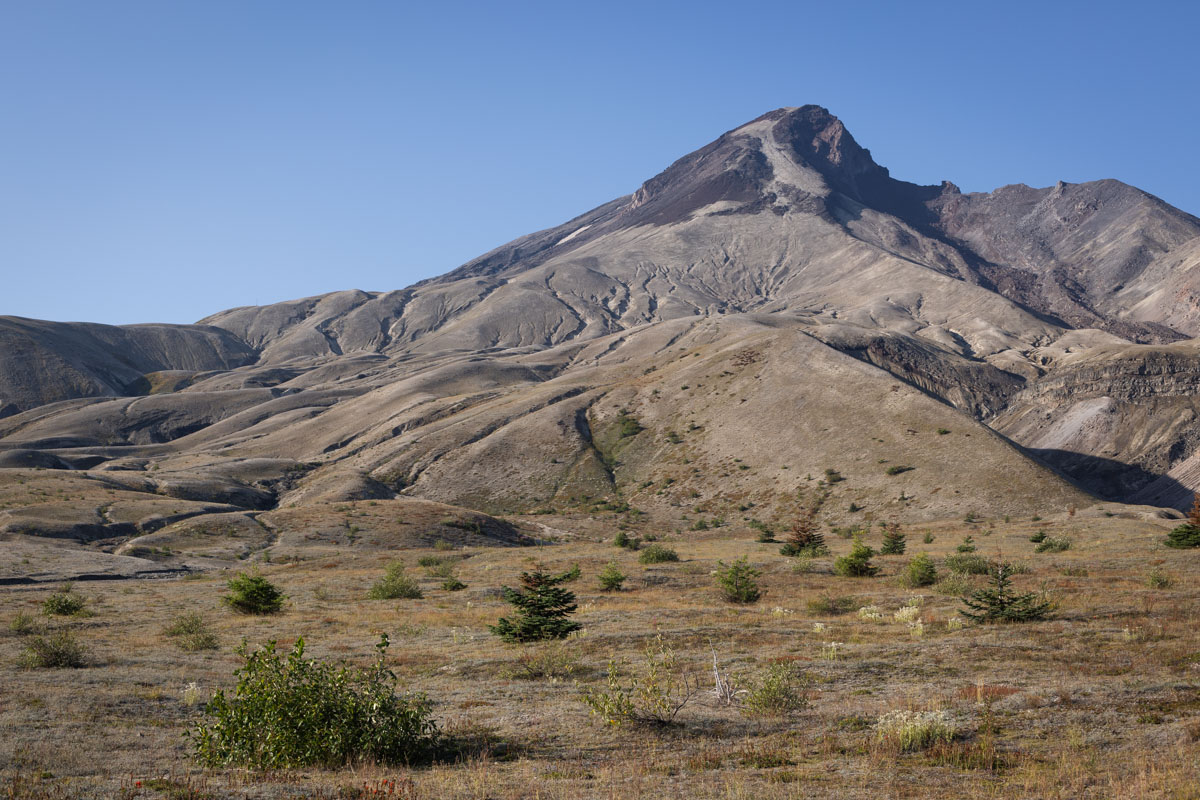
The magnificent mountain we would see inside!
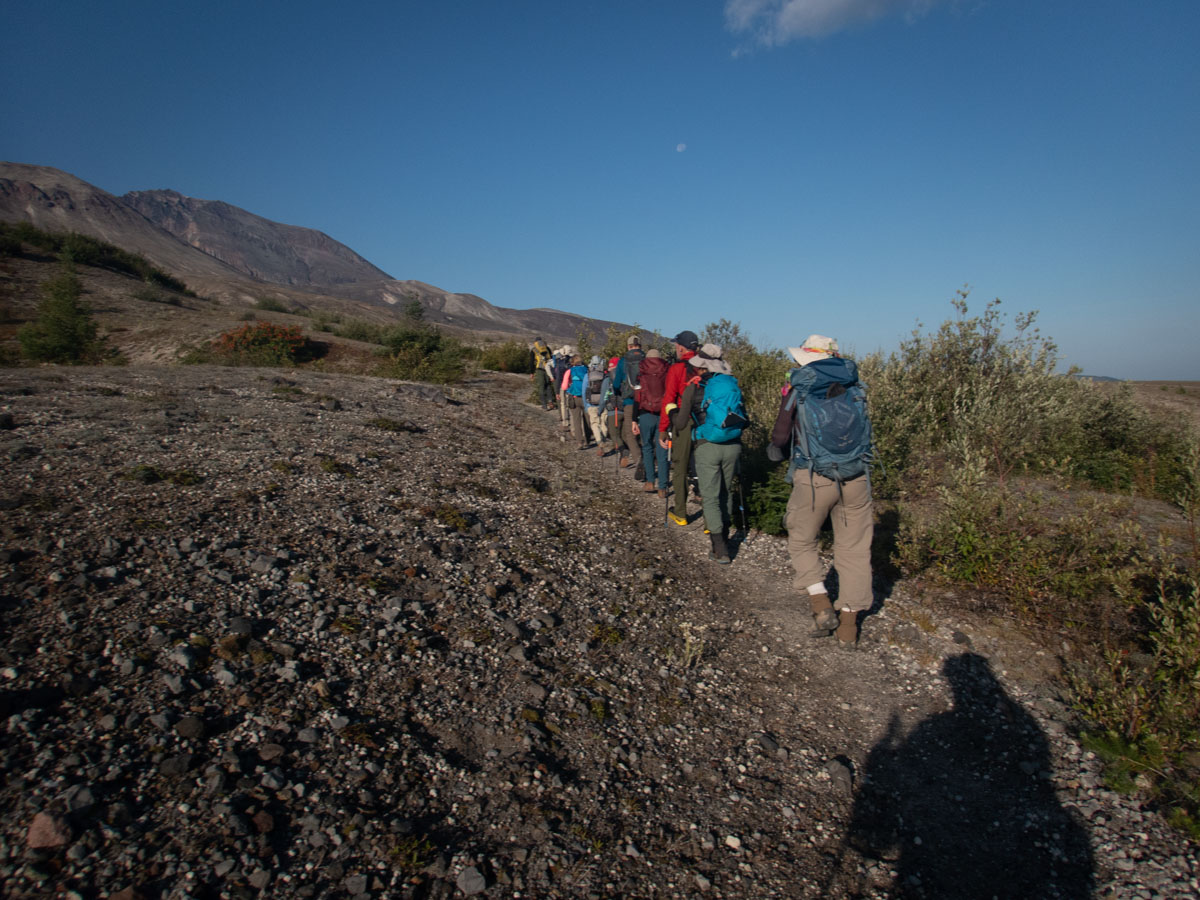
Eric photographed our group hiking up toward the mountain.
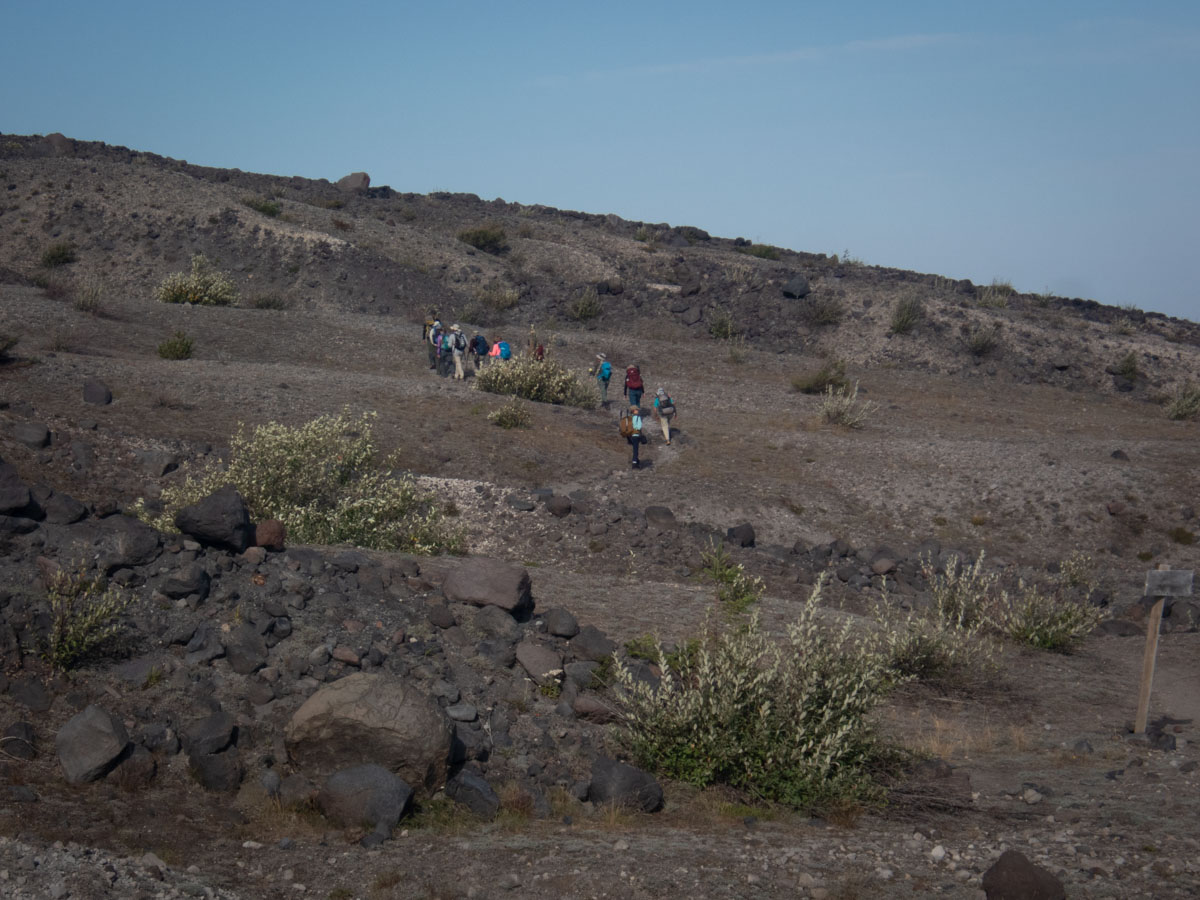
Eric photographed hikers along what Cynthia called the "pumice plain."
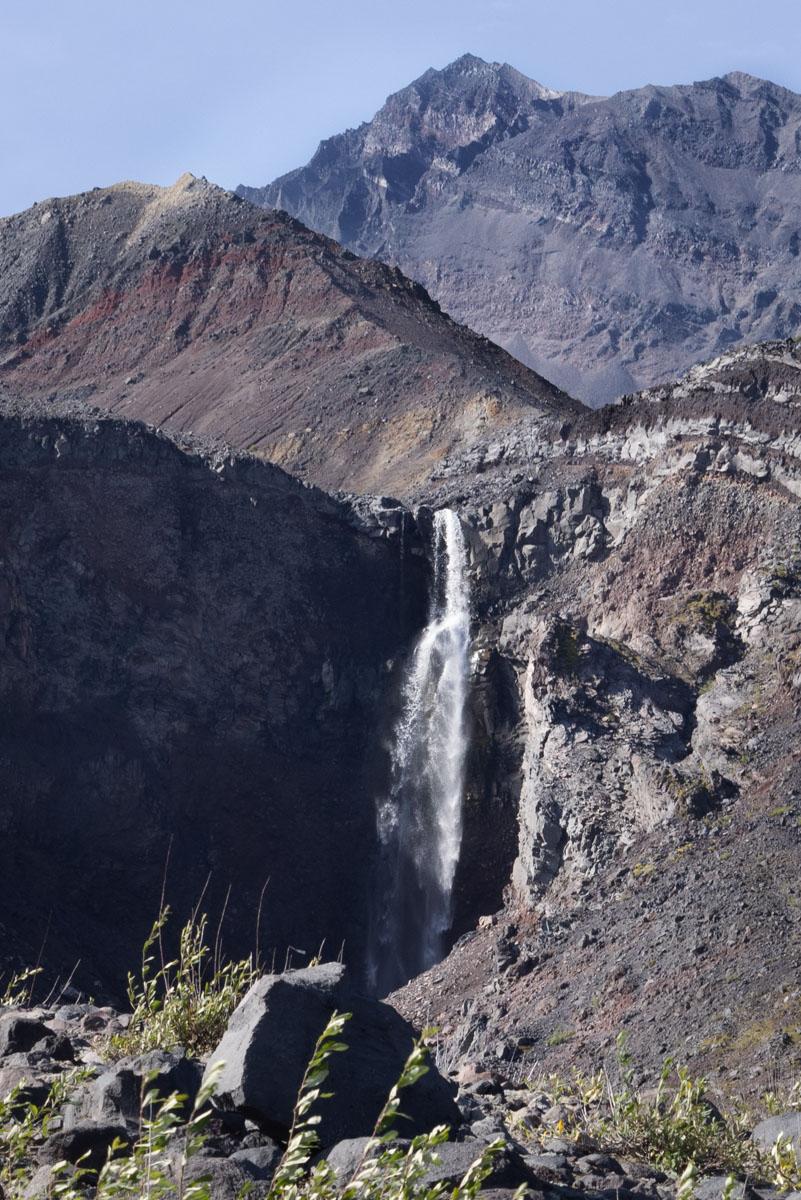
Loowit Falls drops along a precipitous edge on the side of the crater.
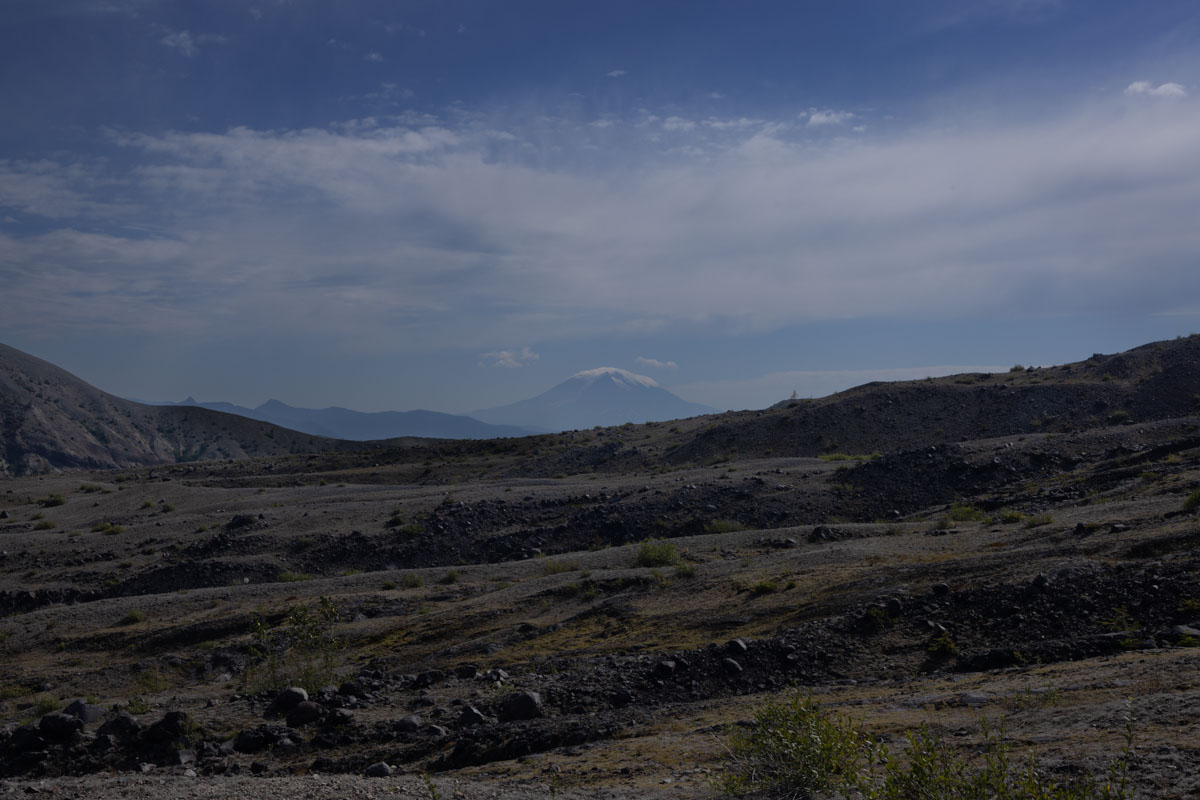
Mt. Adams in the distance. Southern Washington has quite a cluster of Cascades, with Rainier and St. Helens right near Adams.
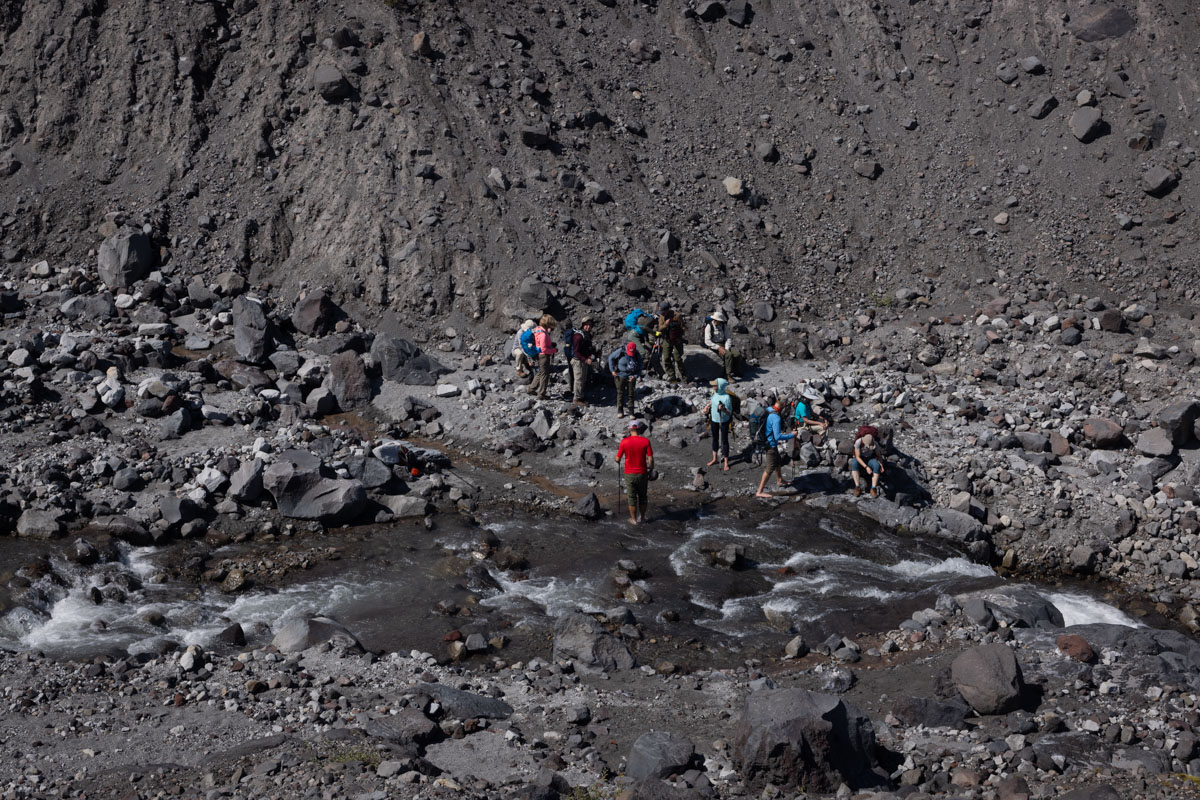
Our guides helped us across a stream. We had brought along sandals for the crossing, but did it in our boots to save time.
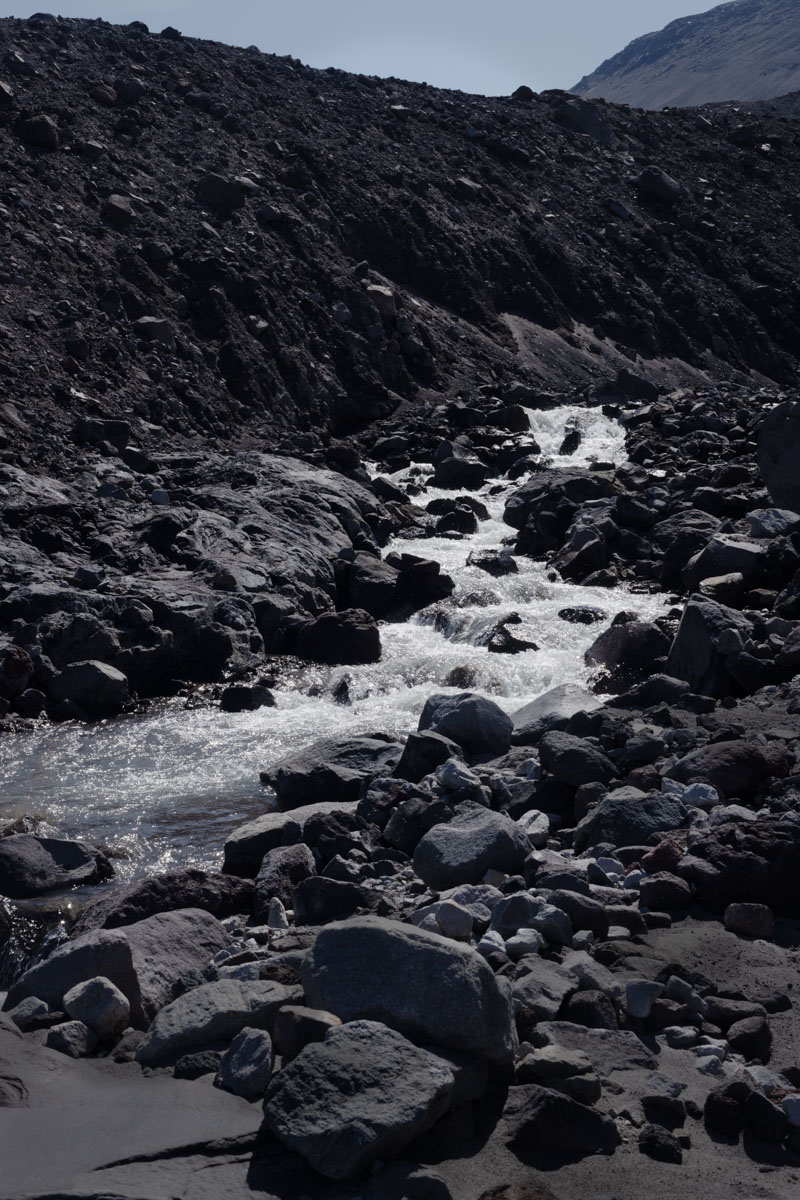
The stream bubbled along through the volcanic debris.
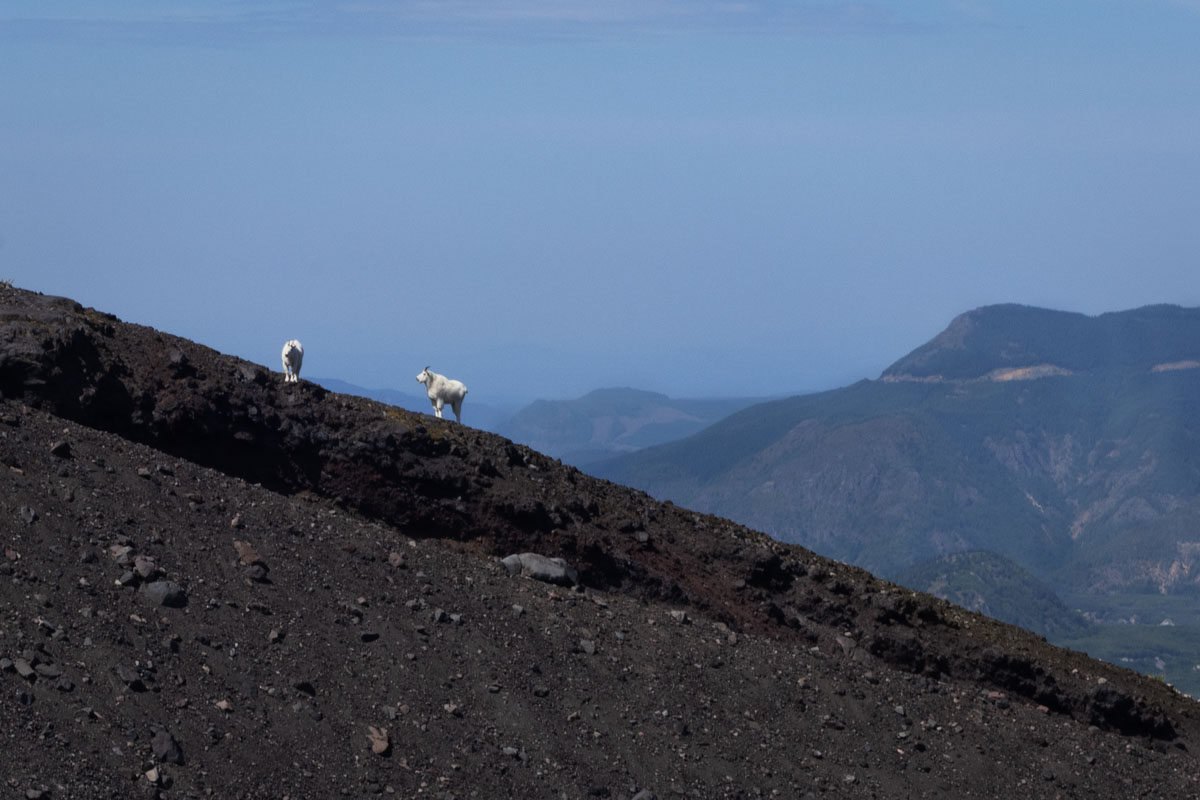
Goats stared down at us from further up on the ridge.
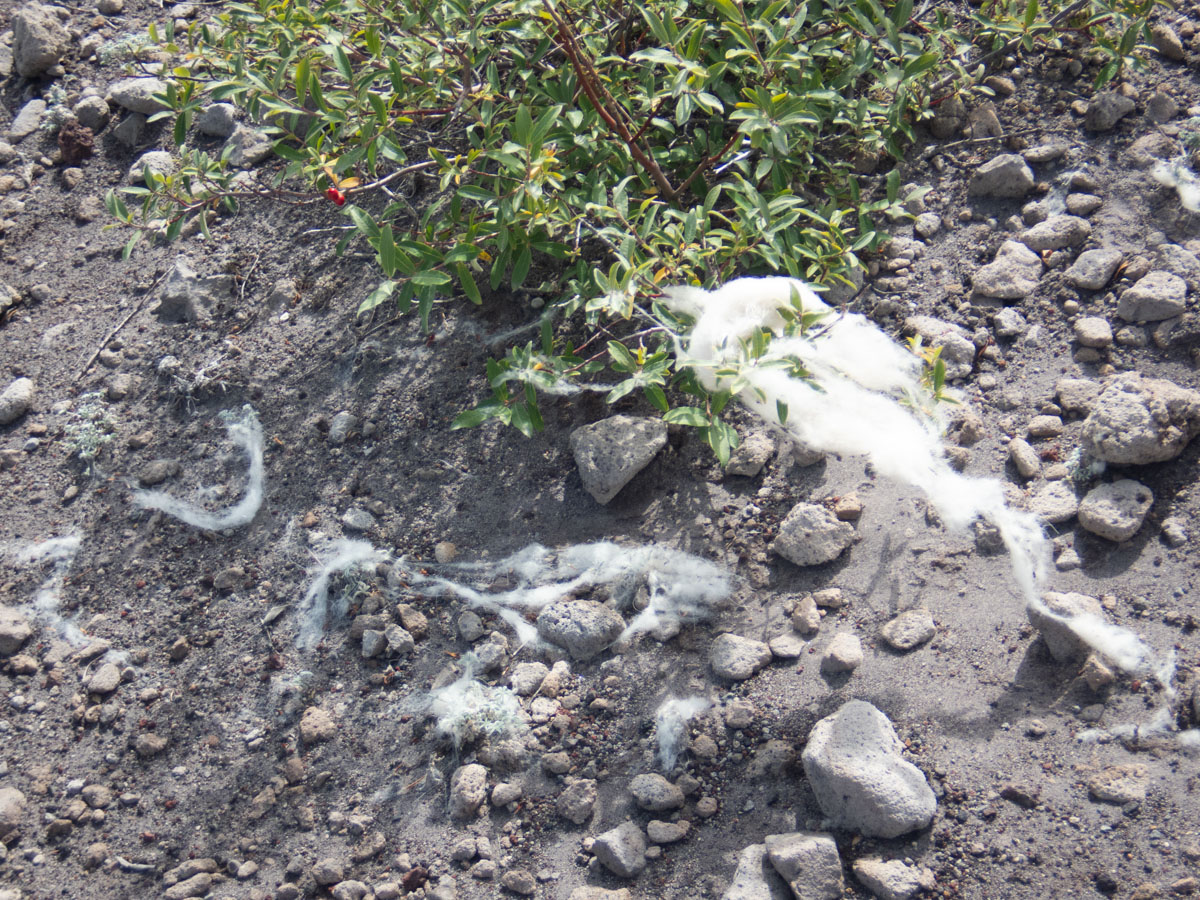
Eric photographed some goat hair that had been pulled off by the few plants on the plain.
We had to leave the main trail around the mountain and go through an off-trail section in order to get into the crater. Special permits are required for this, and our guides told us that more people would summit Everest this year than would be allowed to enter the crater. This was a very special experience!
Gary unfortunately missed the turn for the off-trail section twice, costing us some time. When he finally found it, it was later in the day than planned. He took Eric aside and told him that he was going to take the rest of the group on ahead, and leave Dave to guide Eric up the hill. He hoped to see Eric up at the nose of the glacier, but he needed to move the group along at a faster pace. I thought that my presence might only be a further distraction or annoyance for Eric, and so I proceeded with the larger group, fervently hoping that Eric would make it.
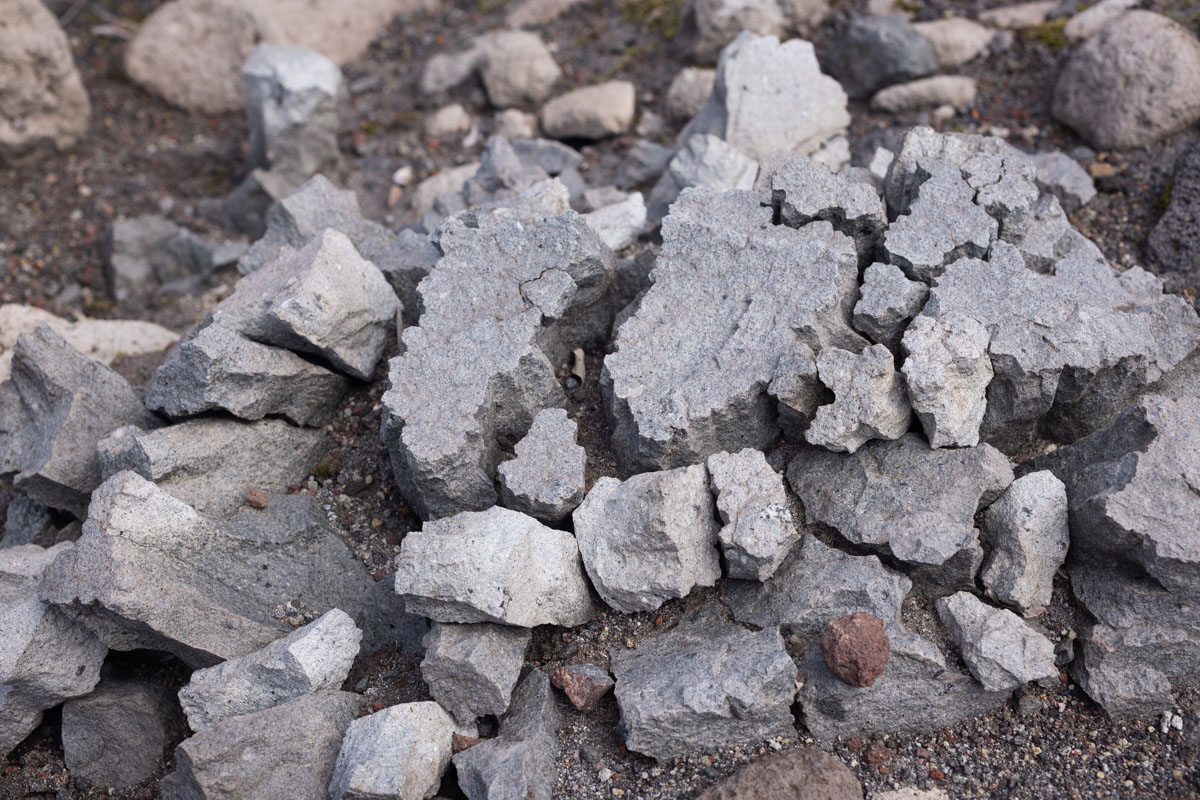
Cynthia pointed out these unusually fractured rocks along the trail.
At last, we reached the crater rim, and contemplated the awesome power of nature.
The outer walls of the crater are older, and the ridge in the lower part of this photo is newer. The top layer is pink because it had been raised to a higher temperature.
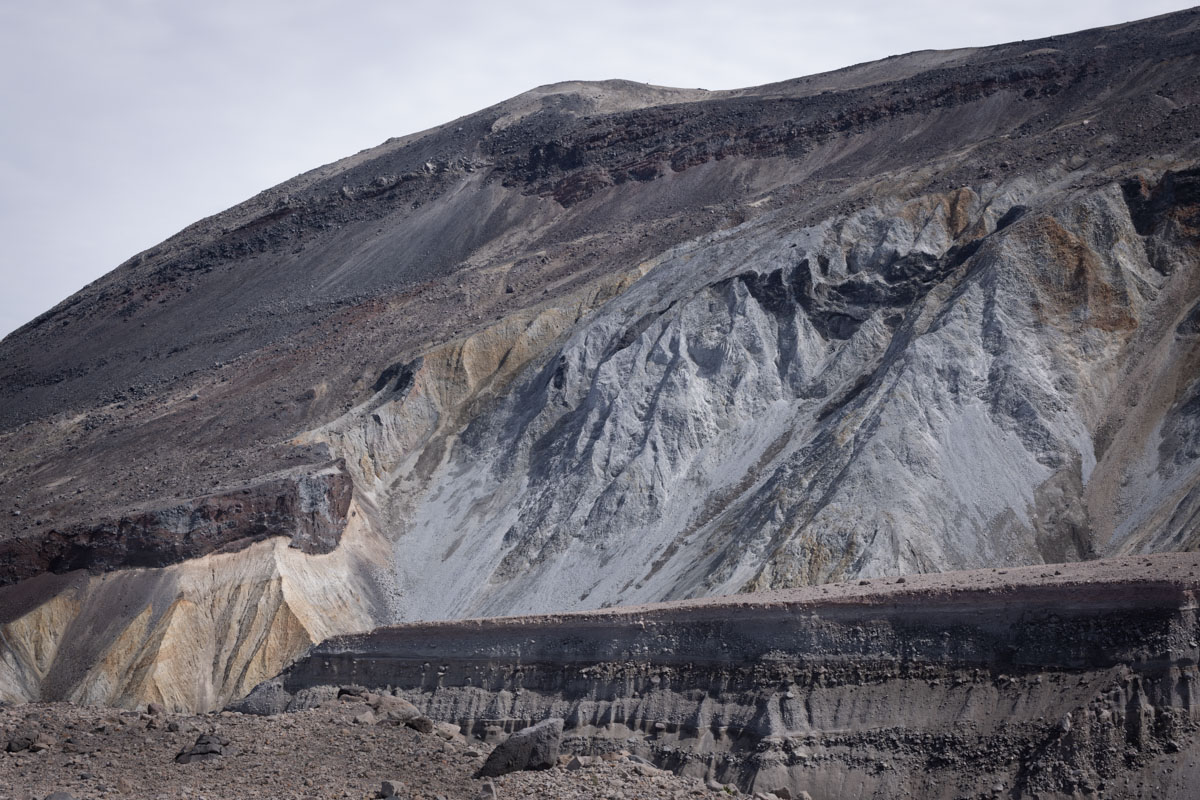
Detail of layers of mountain coming together.
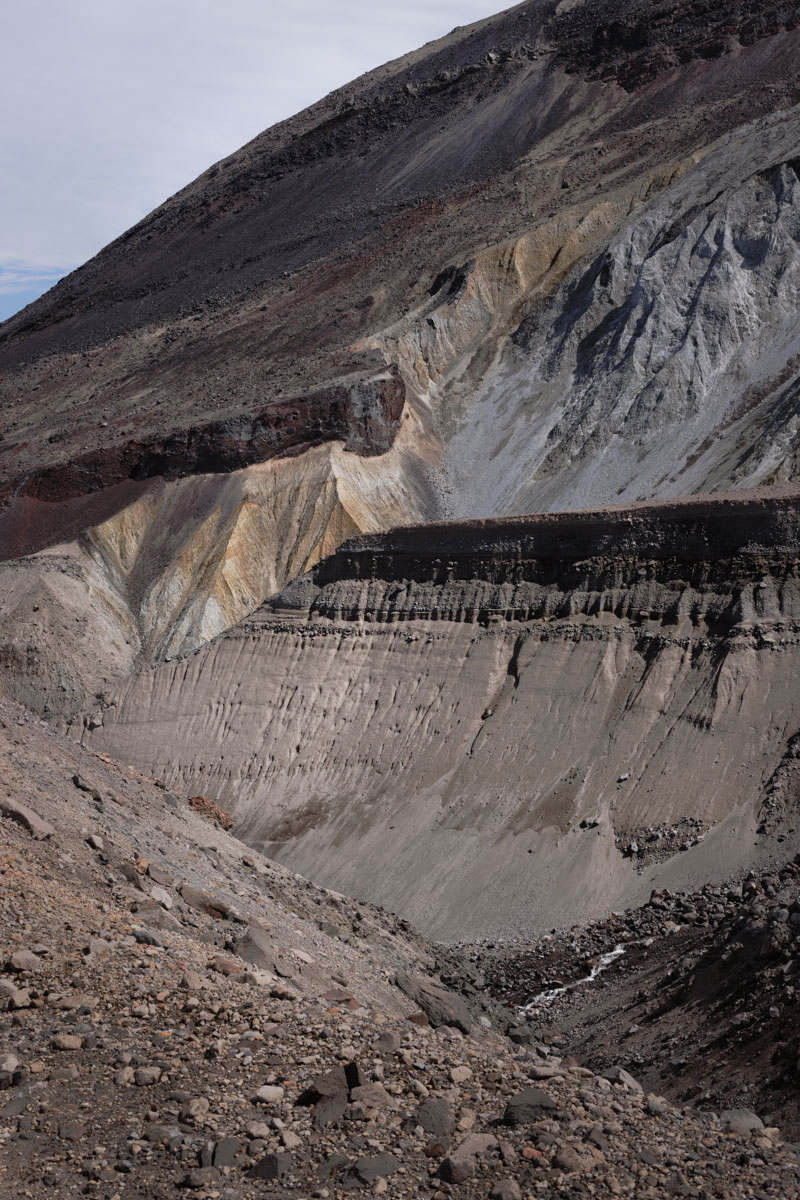
The incredible beauty of the inside of the crater.
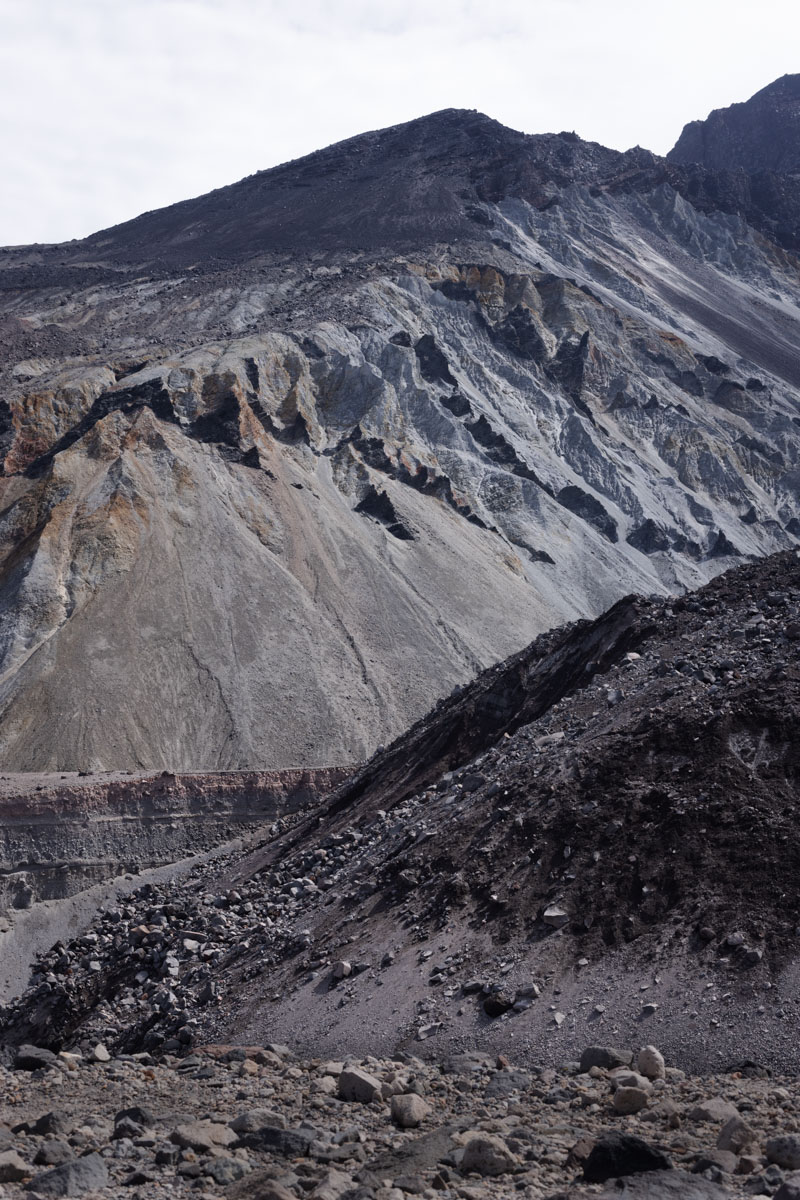
The glacier inside the crater. This is one of a few glaciers on Earth that continue to advance, and this one does so mostly because it is in the shadow of the crater rim much of the day. It doesn't get as much sun as other glaciers, so it has fewer freeze-thaw cycles. Rather than moving along melted liquid water beneath it like most glaciers, it moves along a muddy debris flow. Thus, it moves at a more even pace than most glaciers, which stagger with their freeze-thaw cycles.
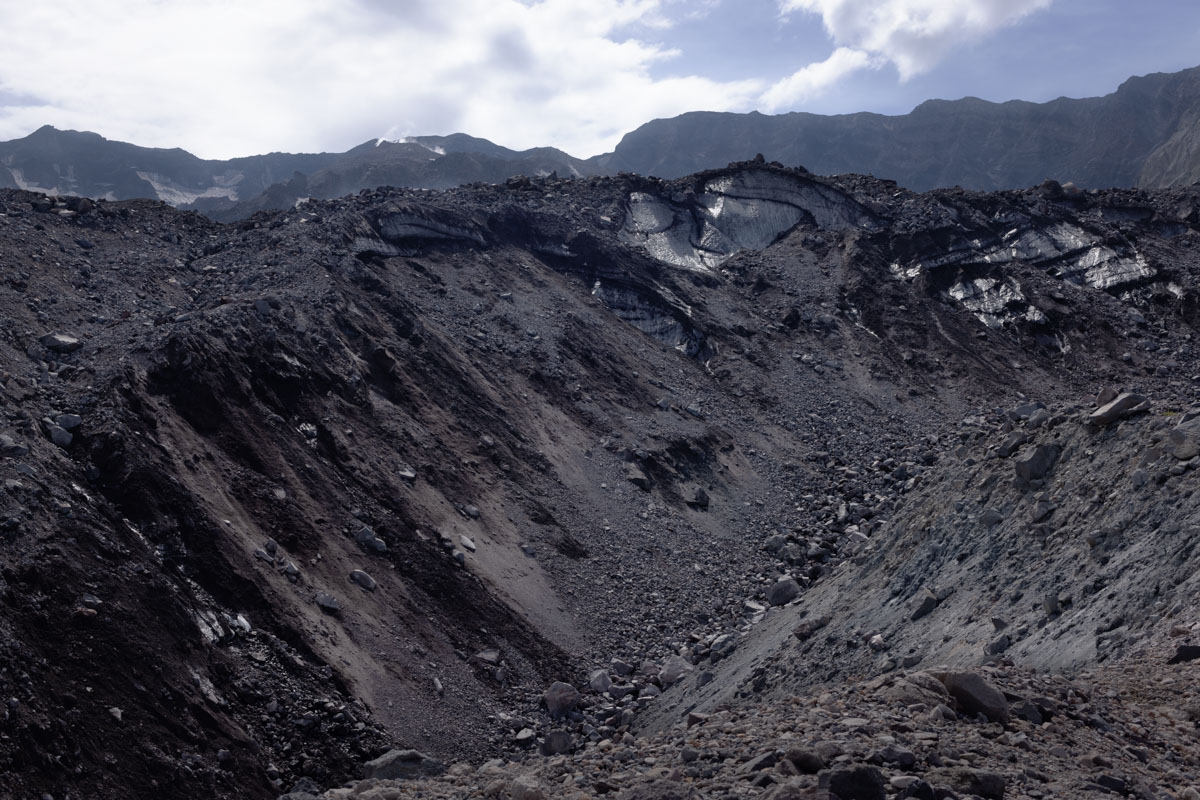
Blackened ice recently exposed by rain, an especially unusual sight.
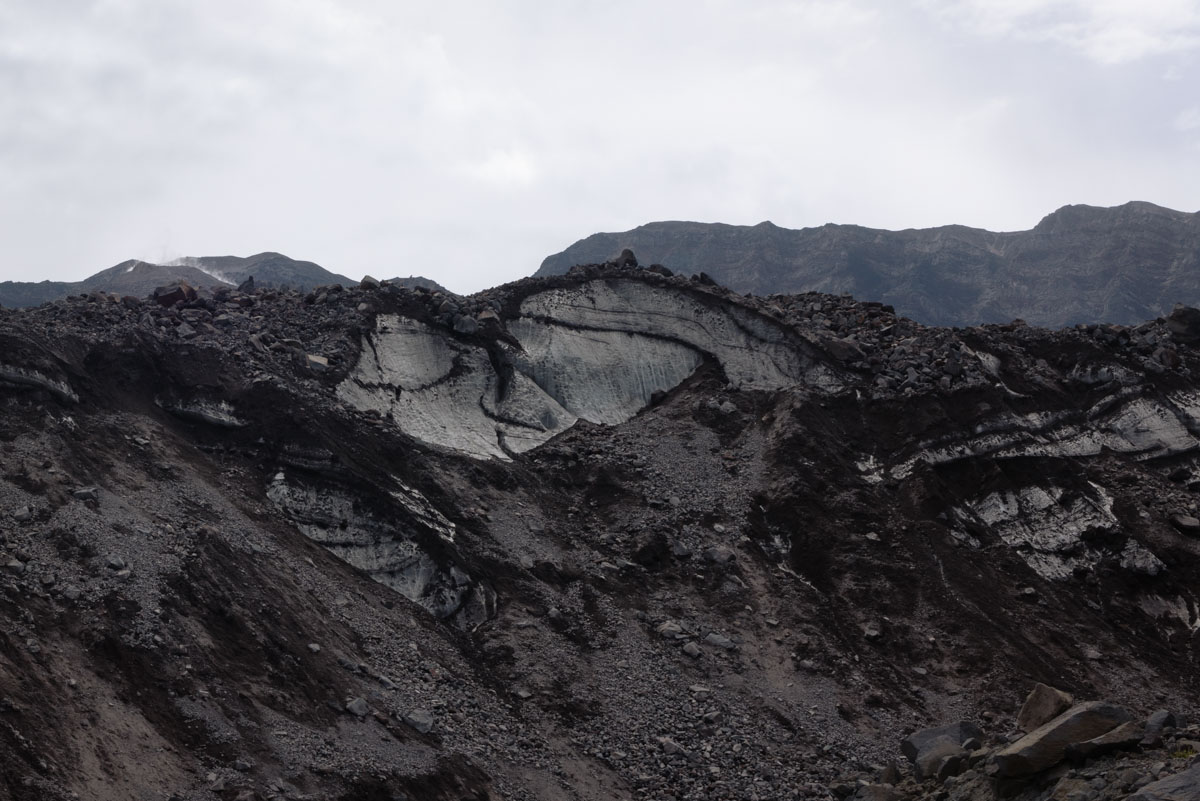
The black points sticking up along the inside of the crater, called dragon's teeth, are bits of lava that tried to force their way out during earlier eruptions.
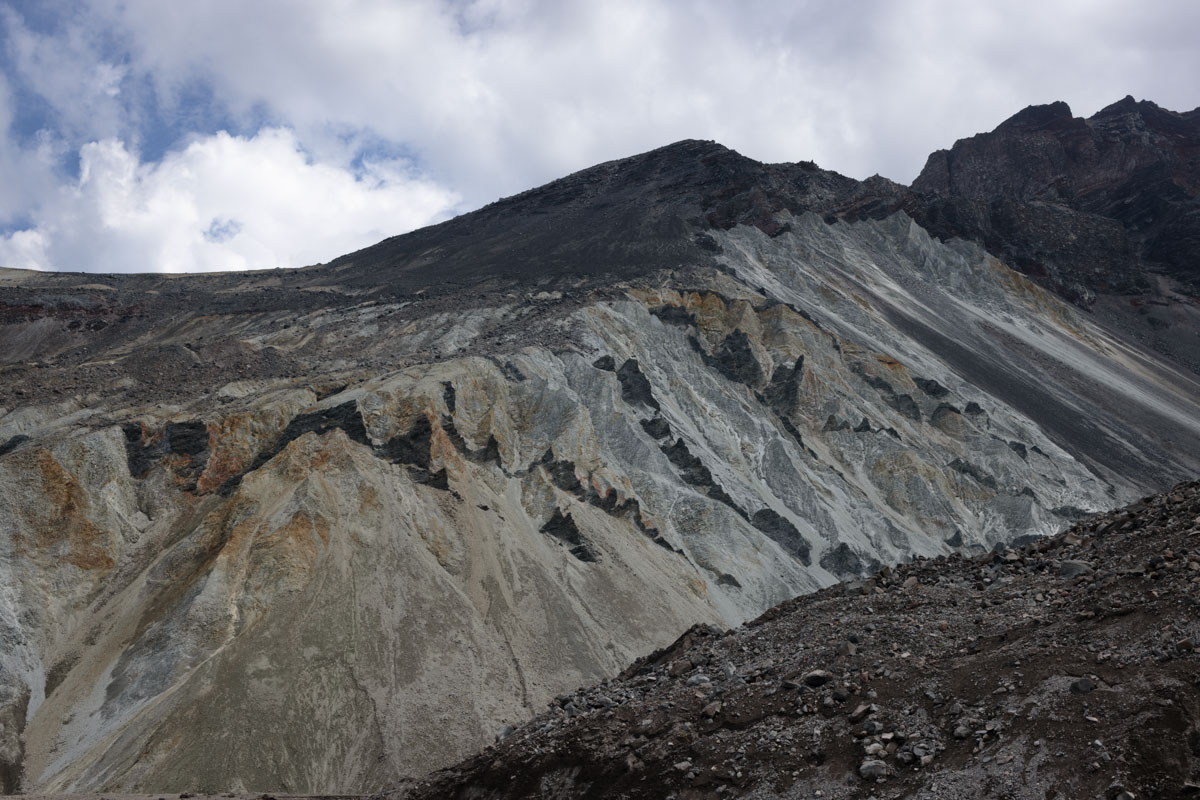
I could see dragon's teeth on the opposite side of the crater as well.
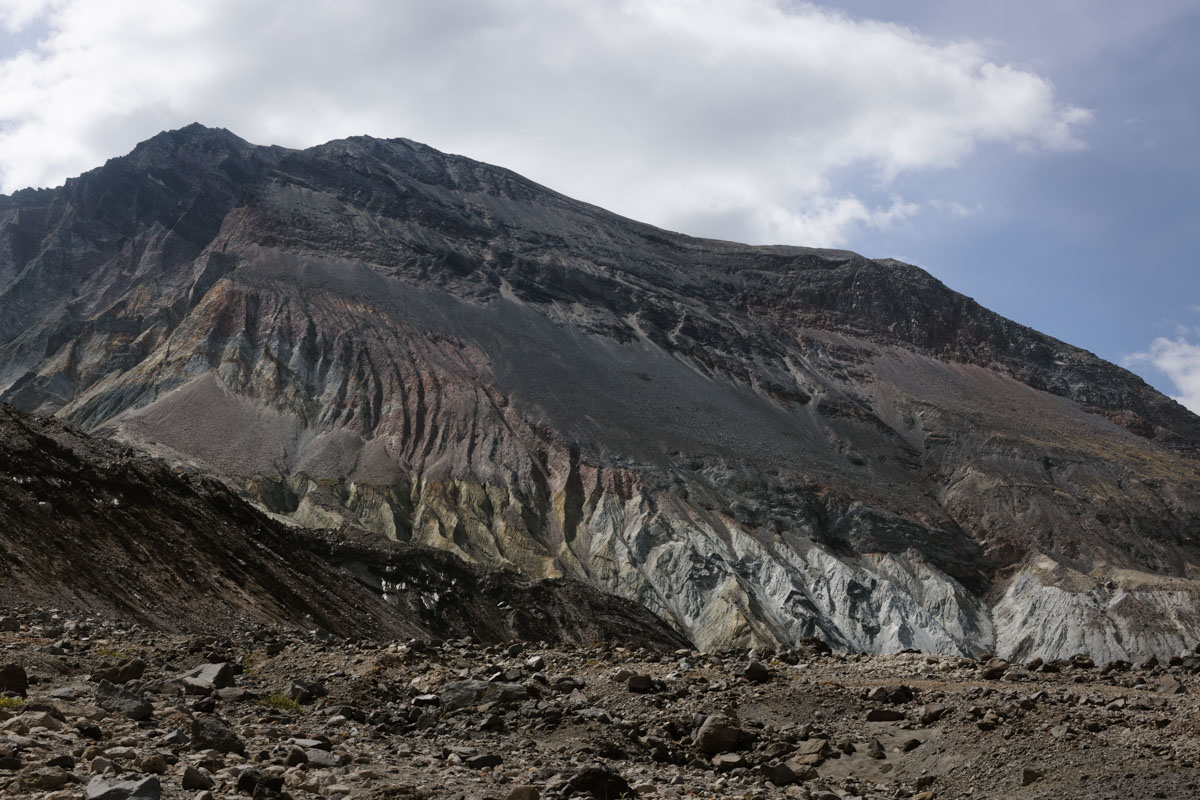
Older rock forming the crater rim.
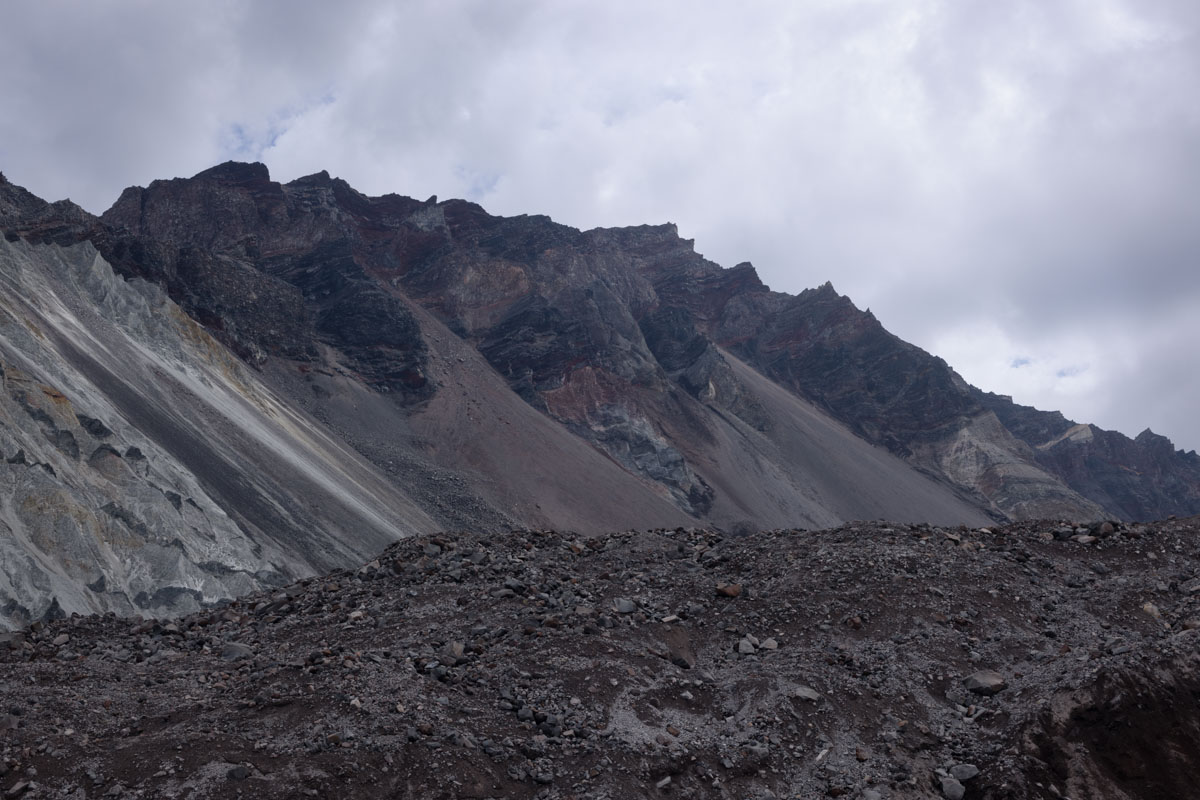
It may seem obvious, but, standing there before this incredible sight, talking to Willie, I realized that what I was looking at was what you would see on the inside of a mountain if you could somehow safely be transported into the middle of it. The rock before us had not been formed by the 1980 or subsequent eruptions; it was the rock that the was there before rock erupted from the center of the crater. There is no word for such a sight.
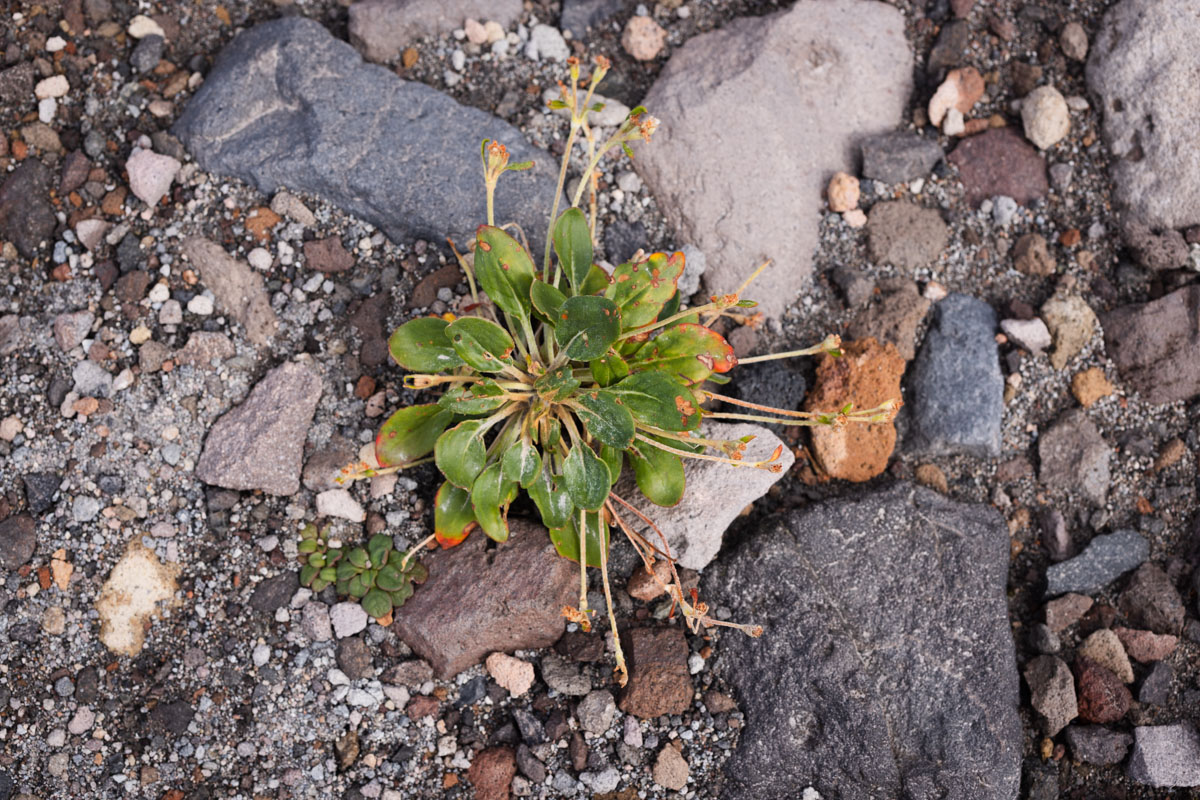
Too excited to eat, and having failed to make peanut butter sandwiches for us before we started out on the hike, I began to notice small details like the pioneering plants growing on the ridge.
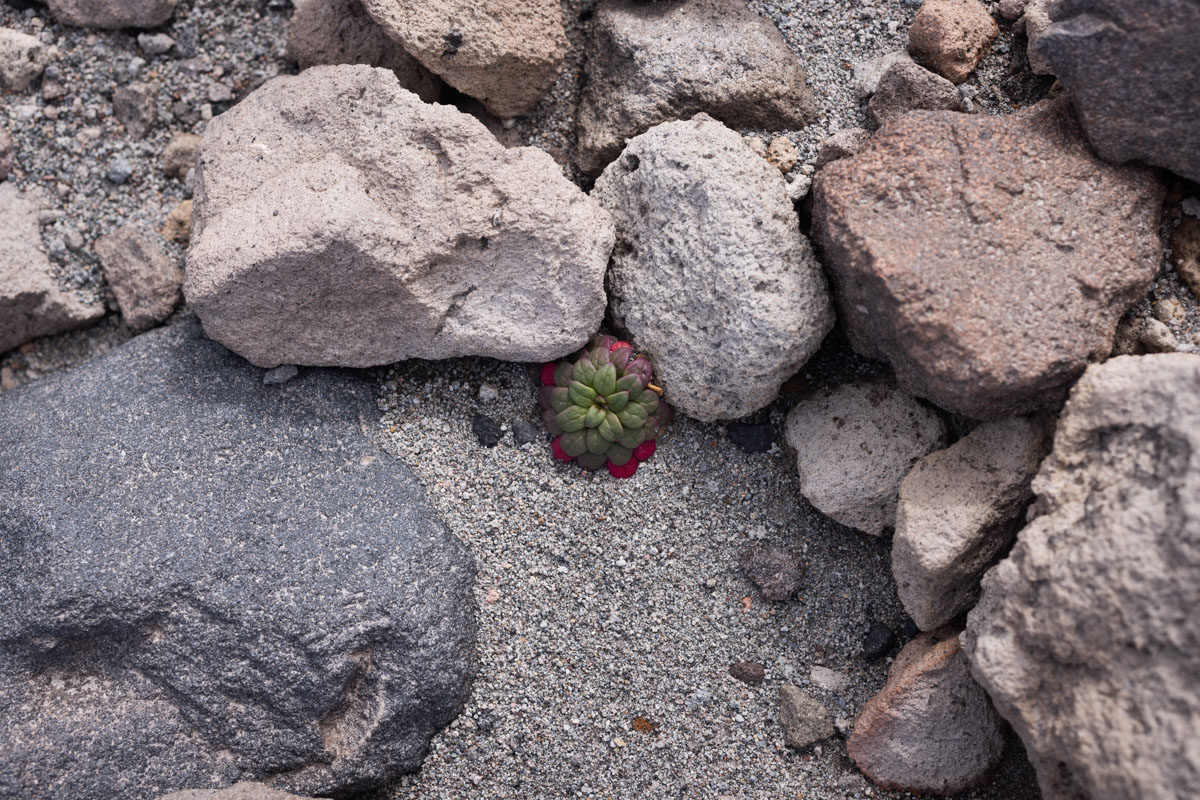
Wild buckwheat.
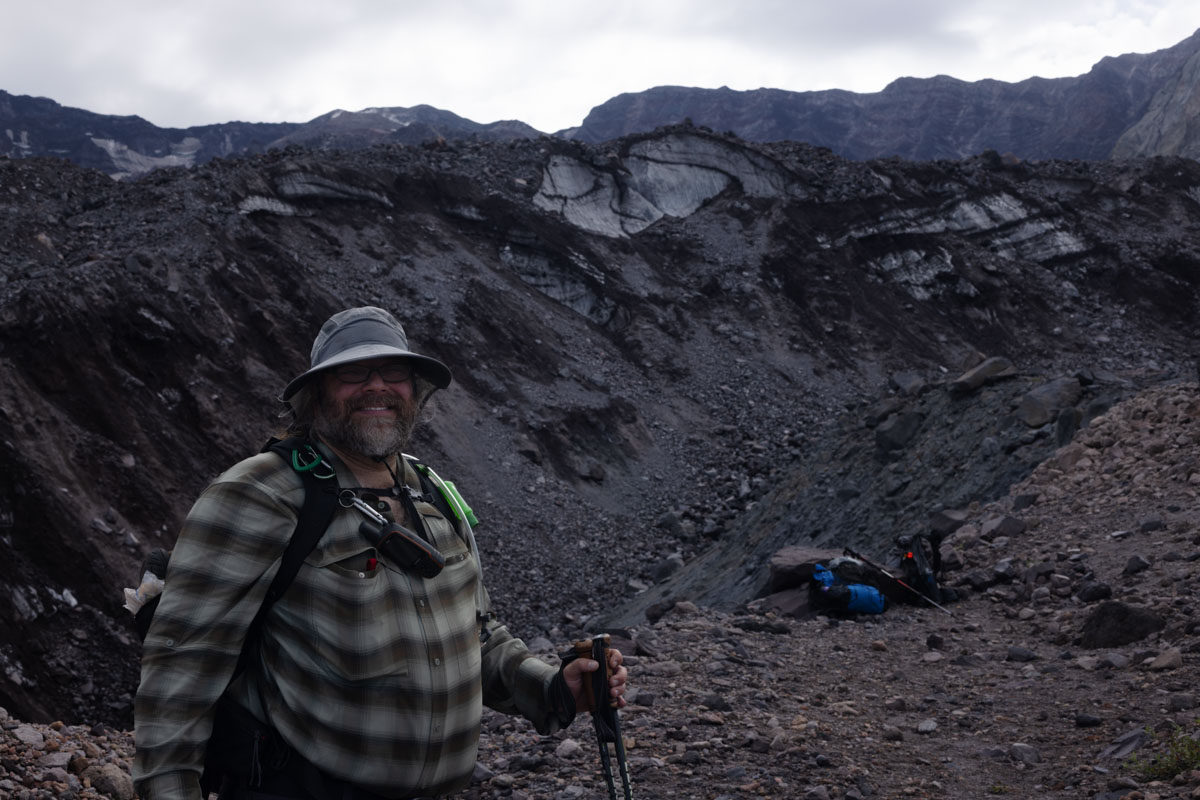
At last, Eric came into view, making it up to the crater rim! I was so happy to see him! We kissed as our fellow hikers applauded.
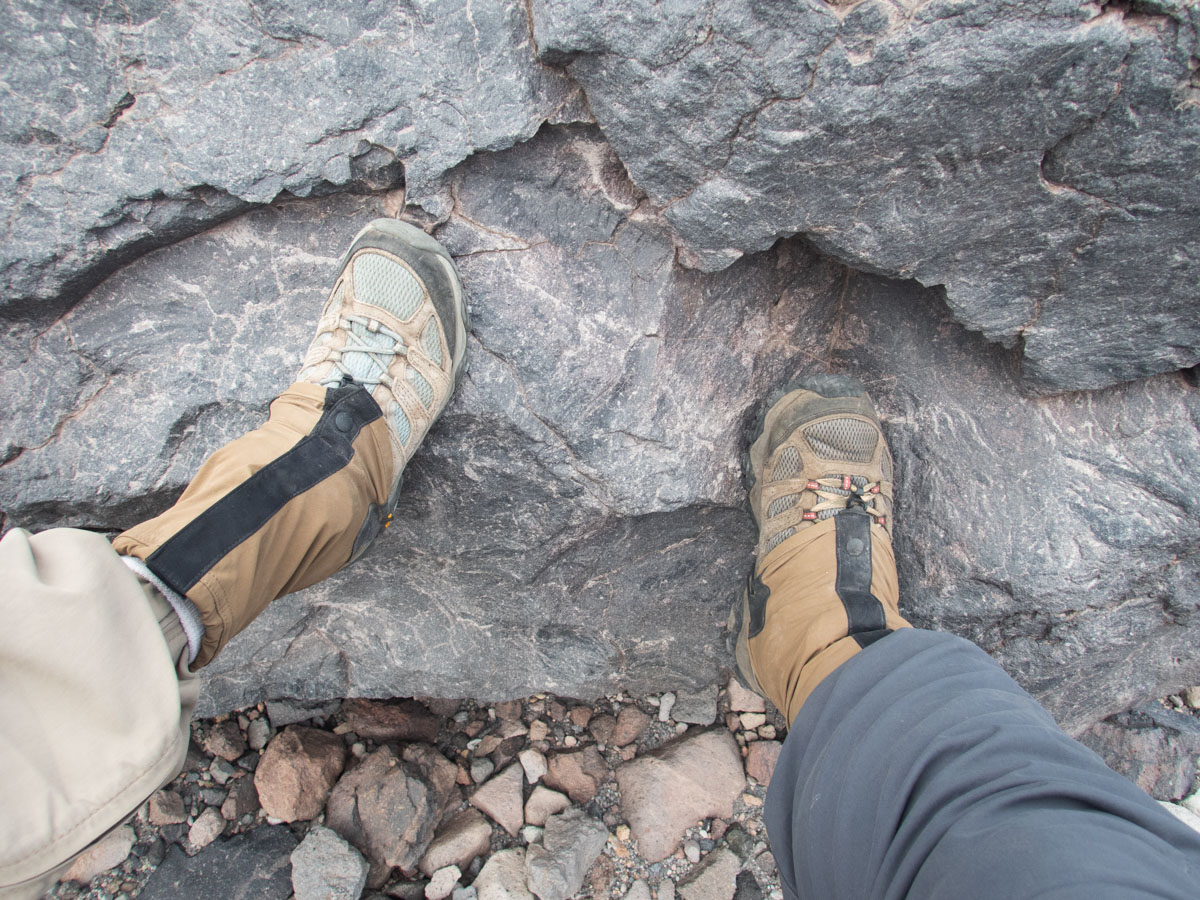
Eric photographed our boots--with gaiters added,for the first time--together on the edge of the crater, and a triumphant Dave took the photo at the top of the page.
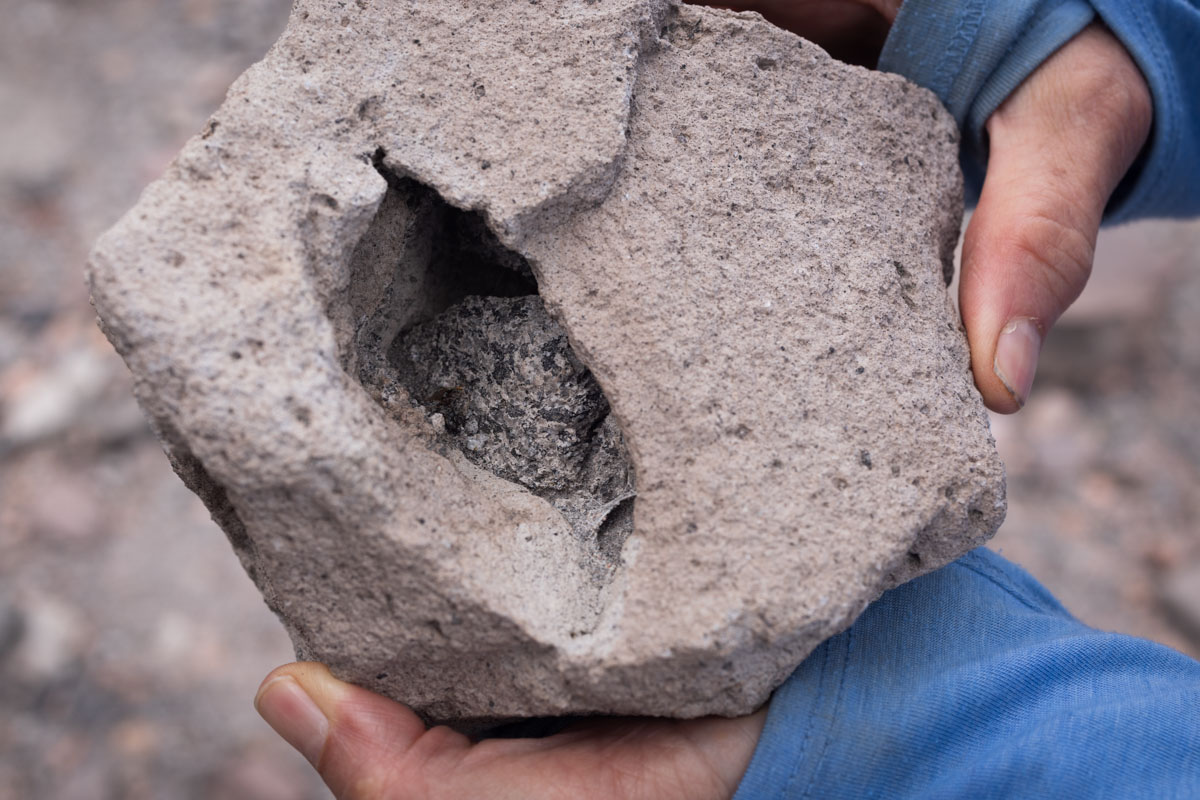
Cynthia and Willie gave a talk in which they explained most of the information above. Cynthia showed us a rock that had oddly formed around another rock.
Eric had me take a picture of him with Cynthia, who was wearing exactly the same hat.
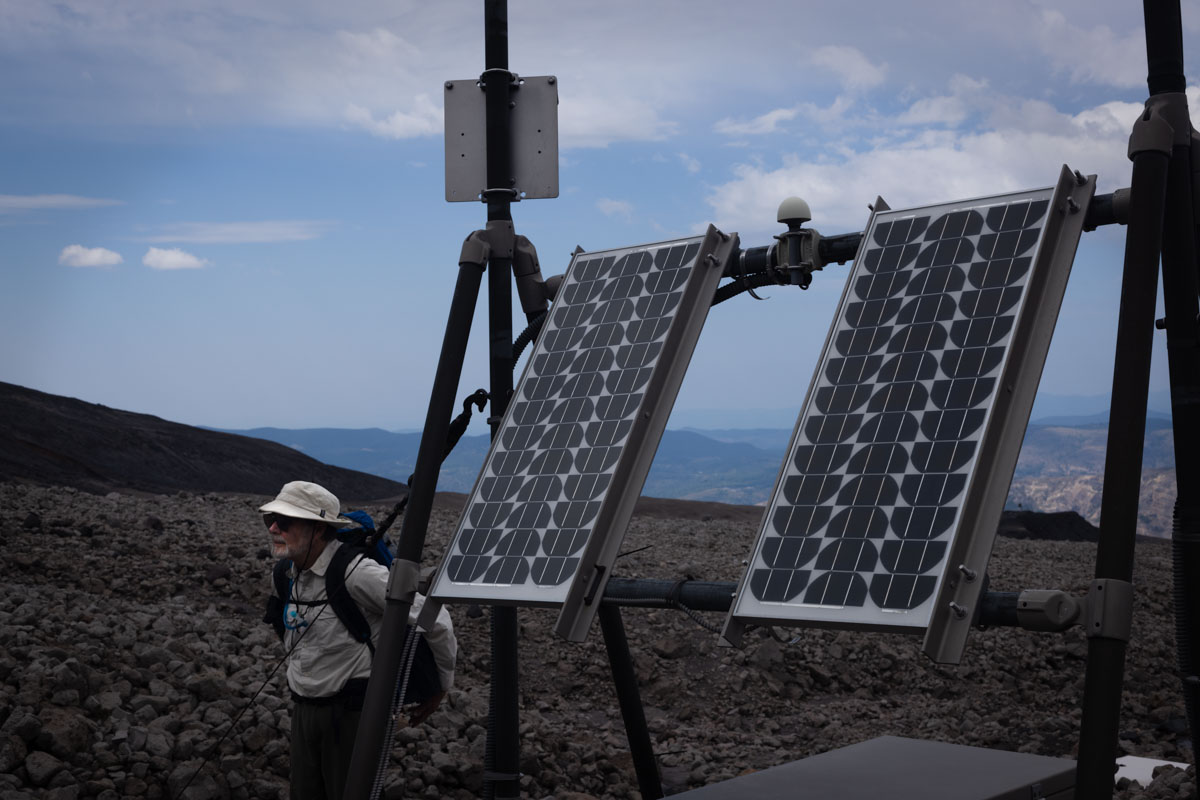
Willie standing beside a seismic monitoring station. As the ridge erodes, the USGS keeps moving the monitoring station, but they are running out of space to relocate it.
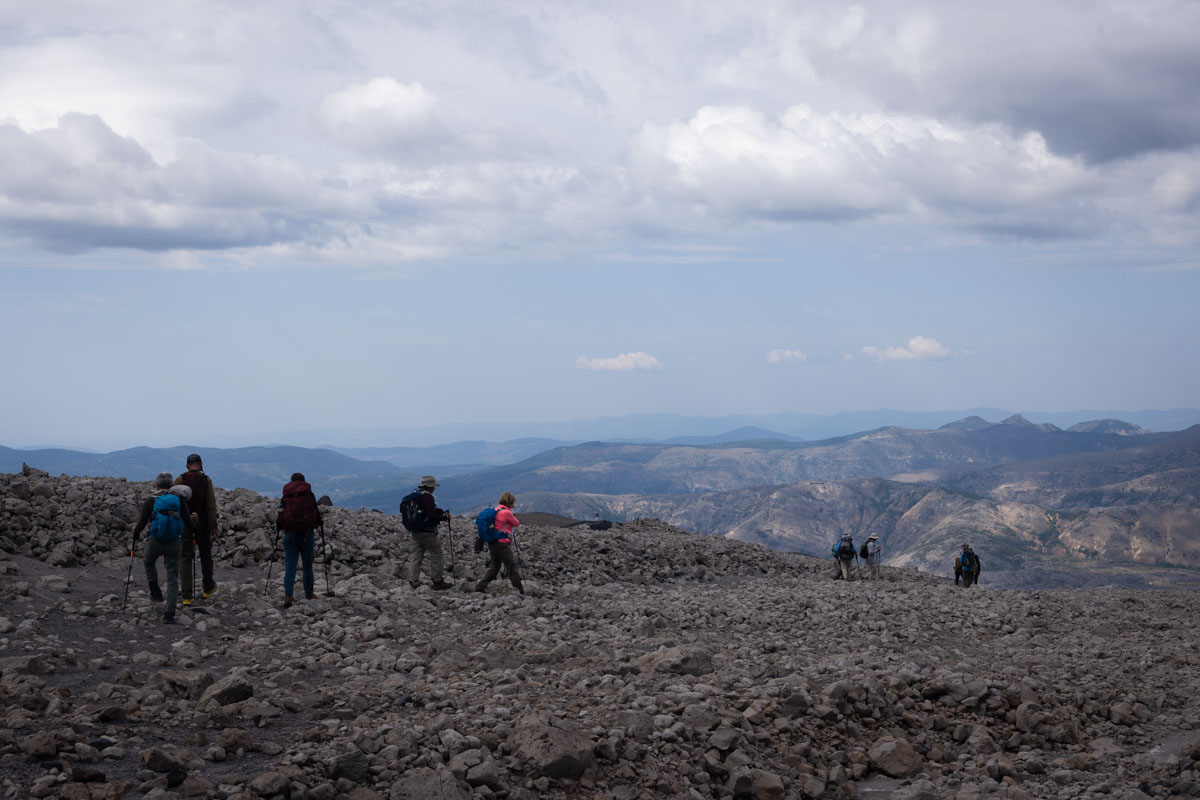
Our group hiking down the ridge. Photo by Eric.
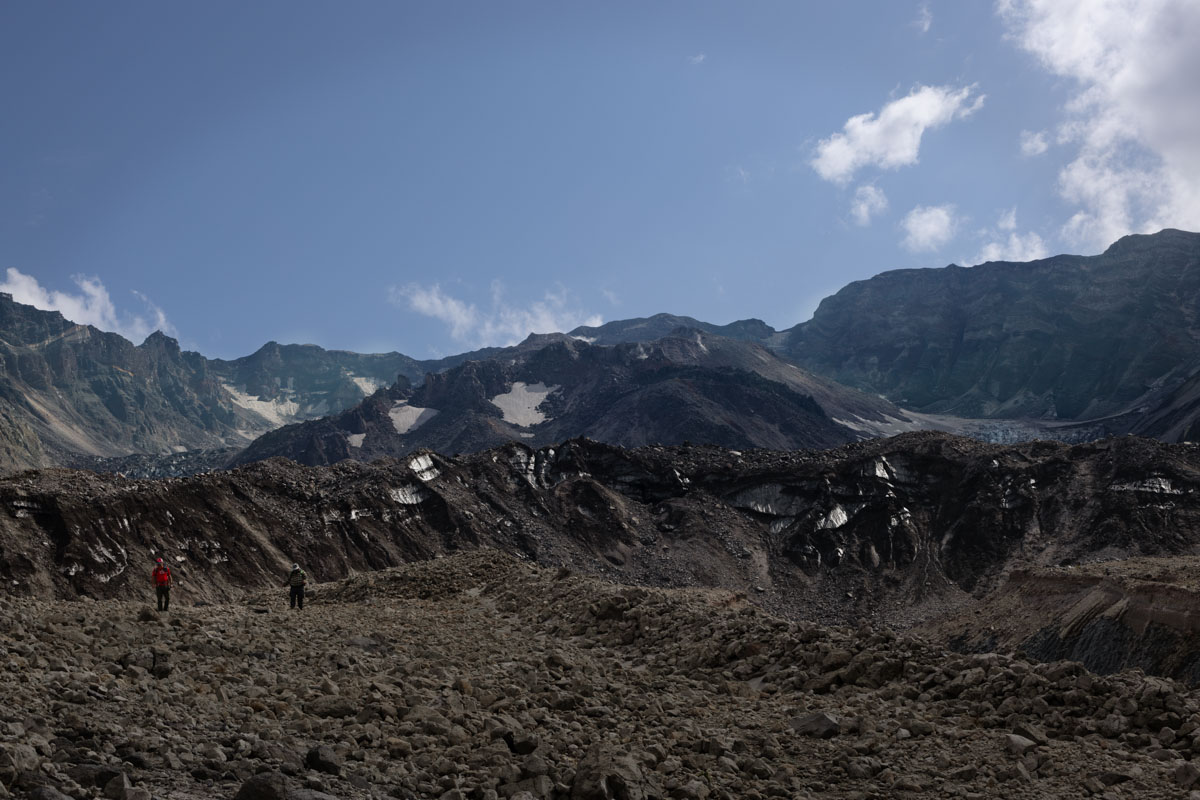
Looking back up, Willie explained that two parts of the same glacier parted and came together again after they went around the dome rising in the middle of the crater.
Eric making his way down the steep slope.
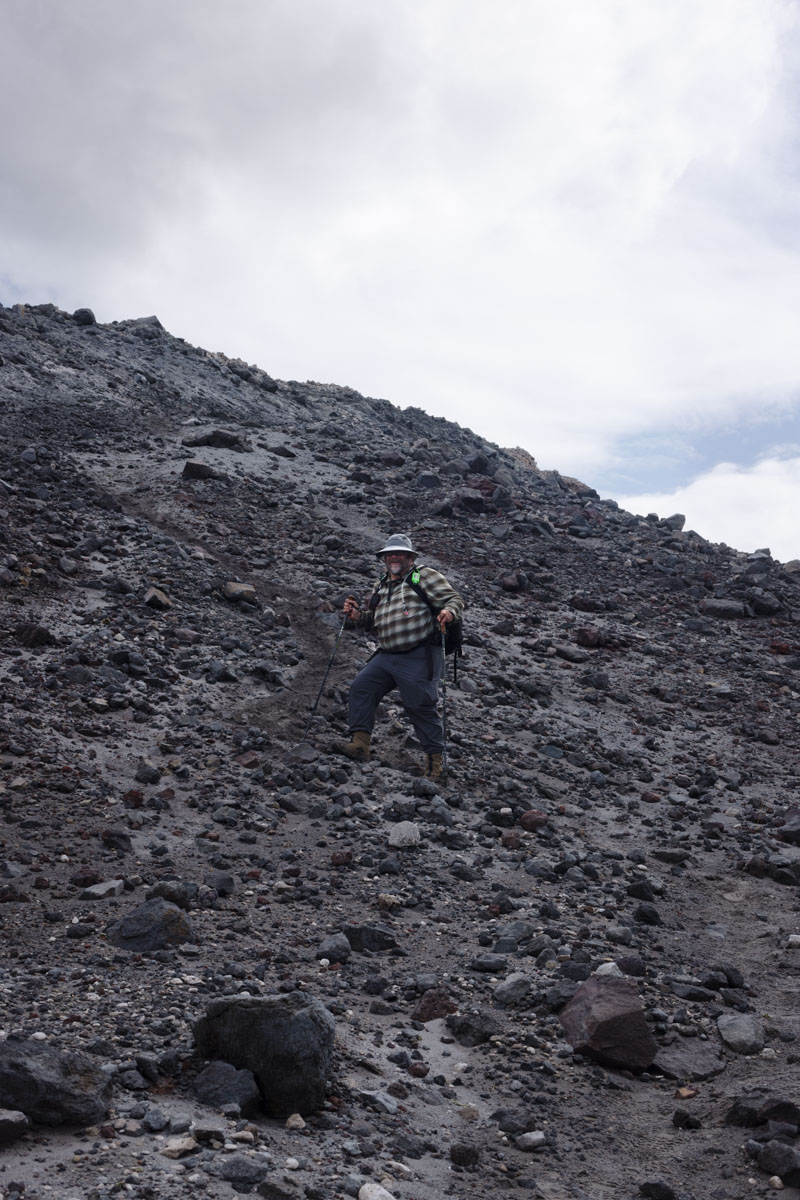
Gary indicated that he would take the rest of the group along, and allow Eric to proceed with Dave at his own pace. I gave him a kiss and told him I would meet him at the bottom.
Looking back up at the dome and the the crater.
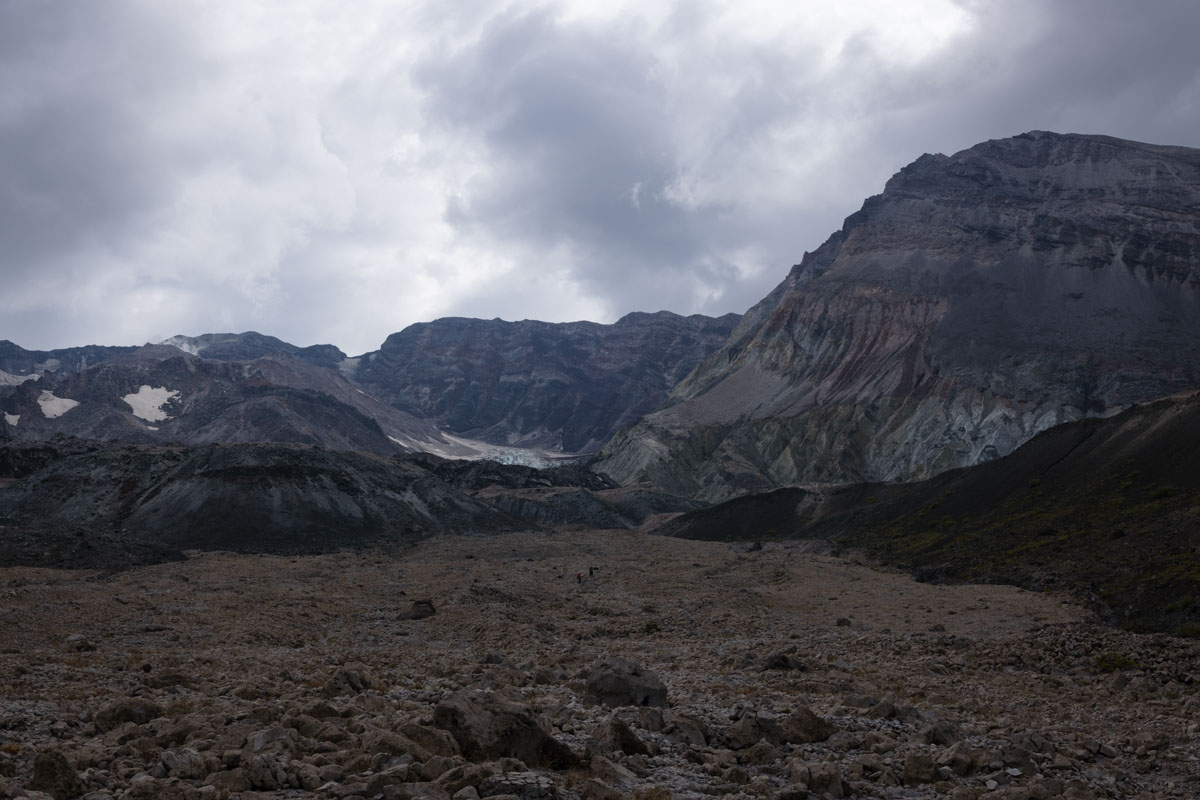
Another oddly agglomerated rock.
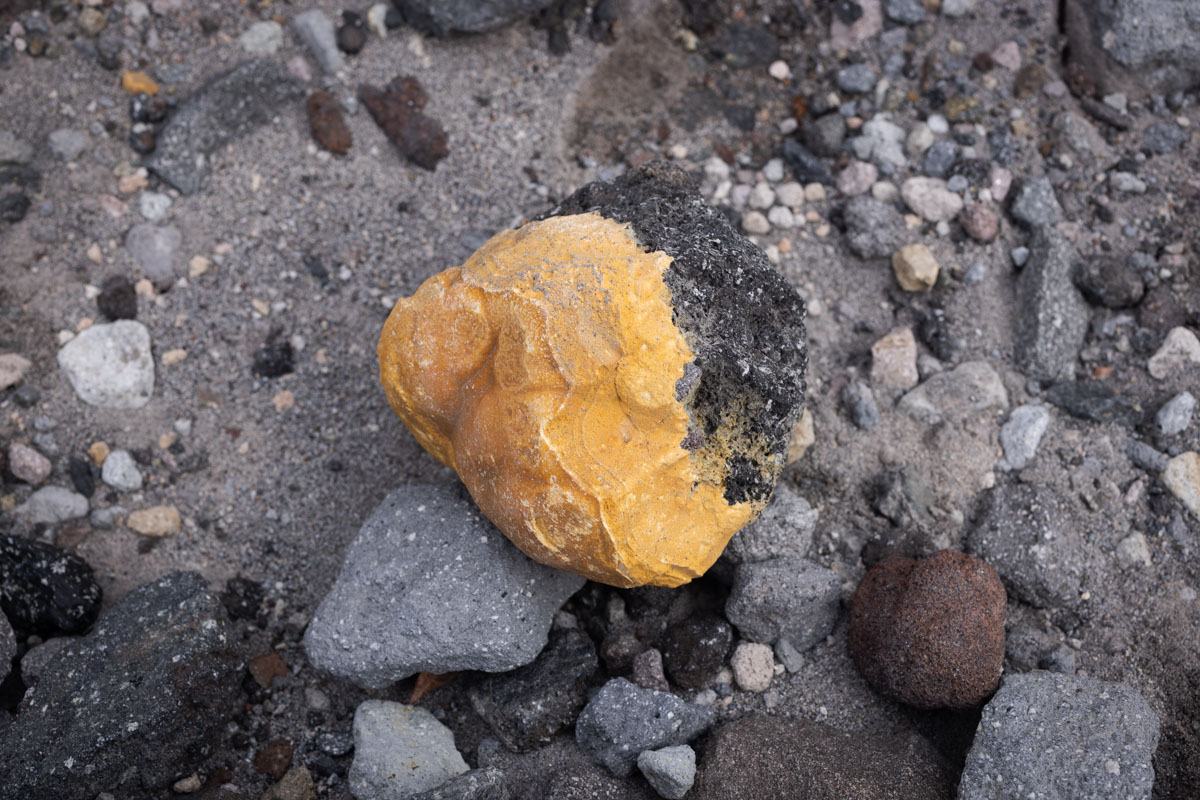
The immense size of the volcano distorts the perspective, so the hikers are actually further from the rige than it appears in the photo, and so less threatened by those boulders that will surely fall someday soon.
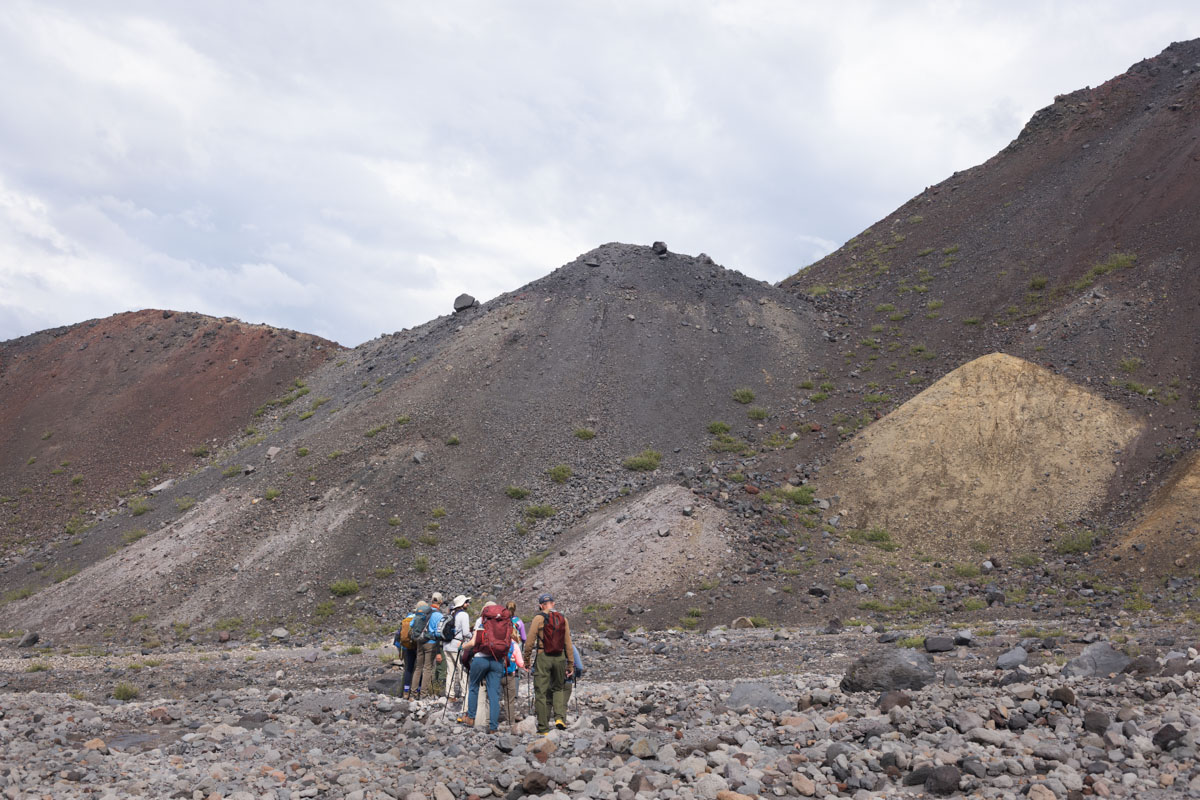
Meanwhile, Eric photographed our group from far up on the ridge.
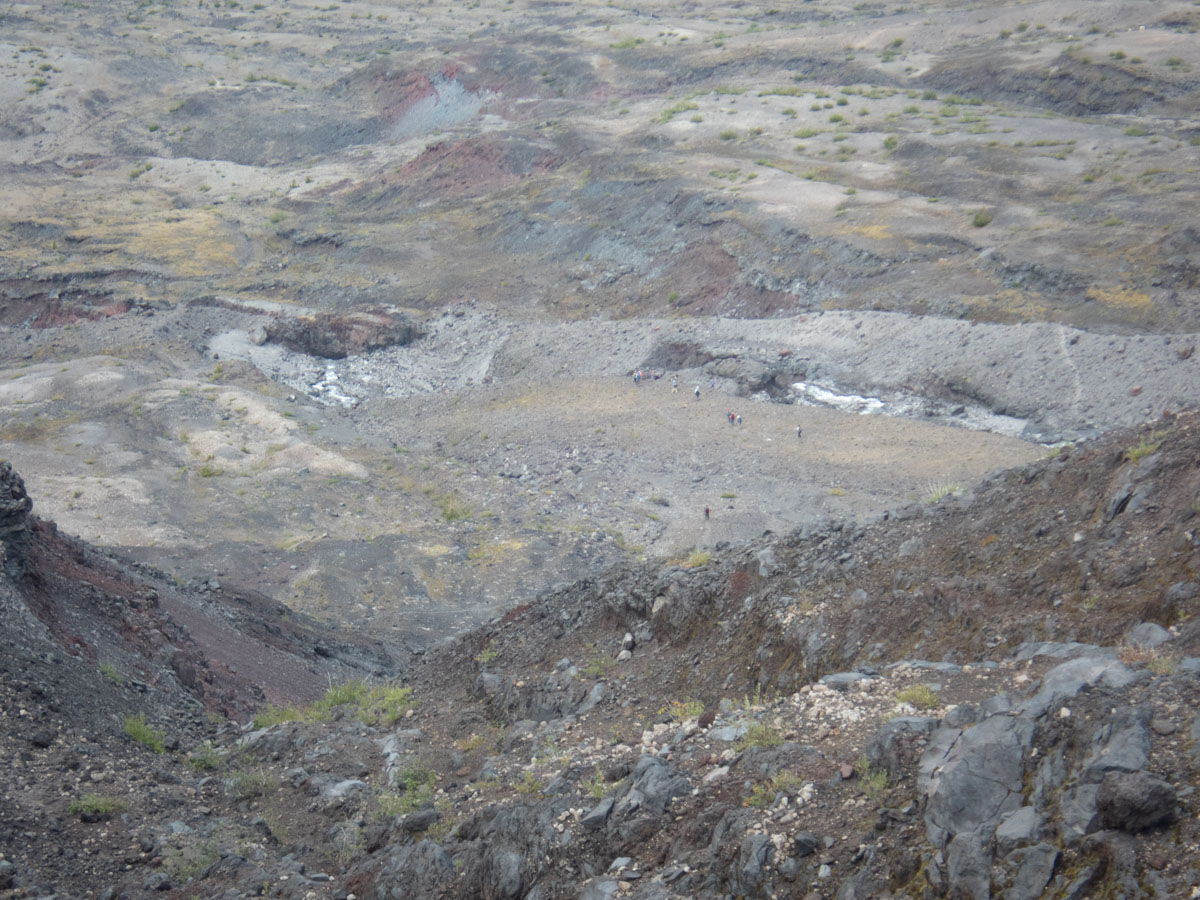
Eric photographed a stream running out of the volcano.
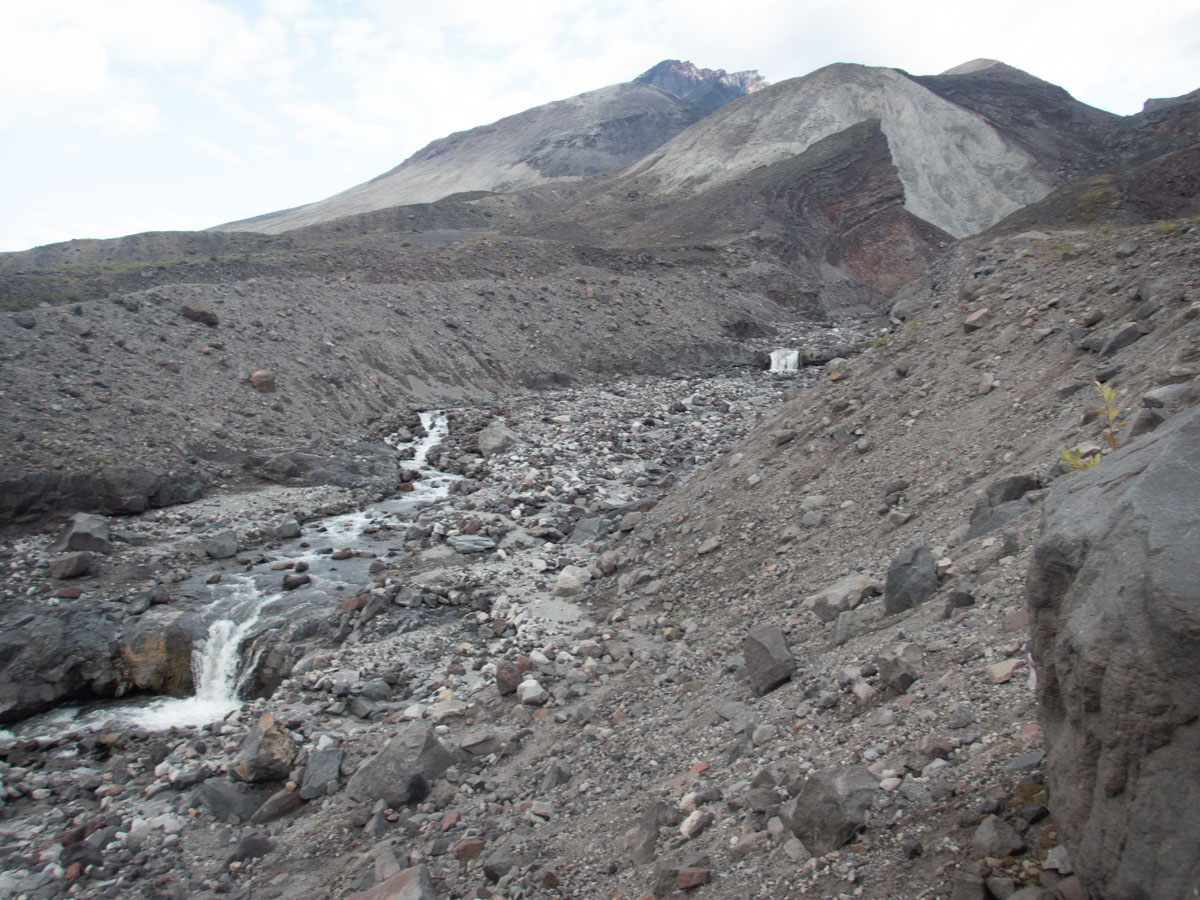
A patterned rock wall above.
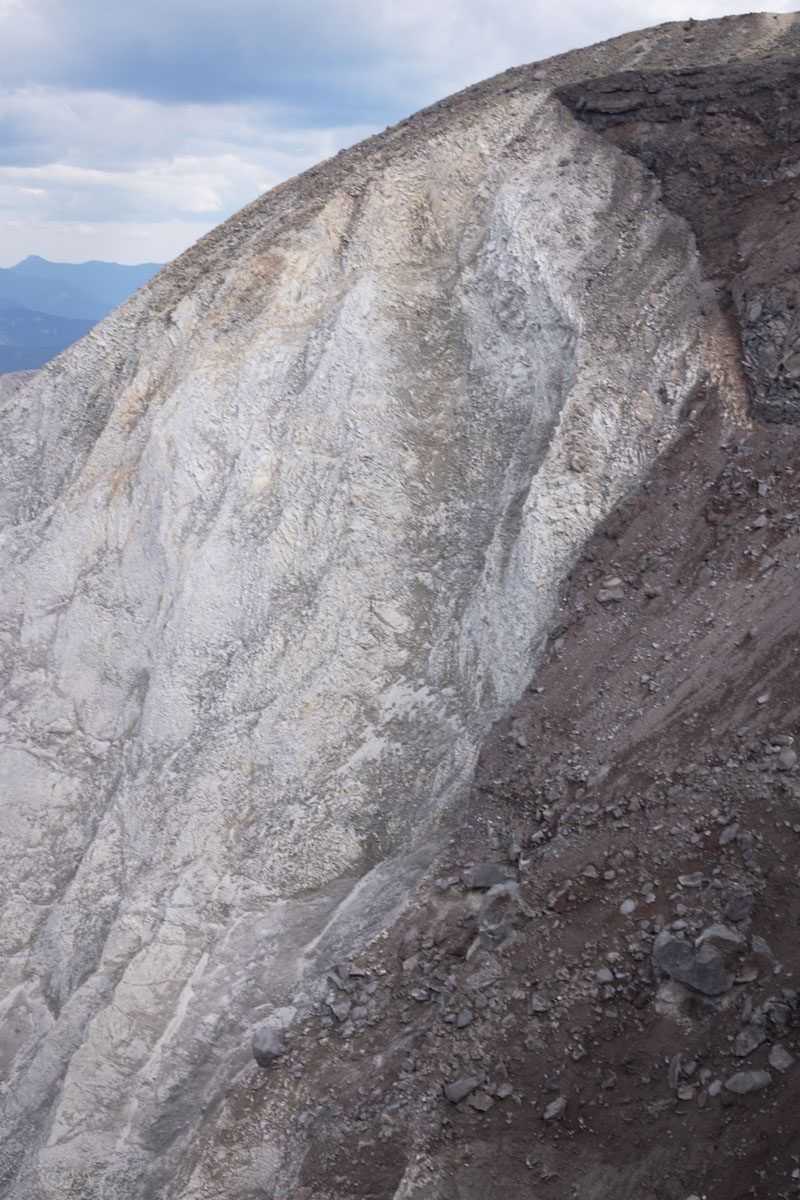
Cynthia found an example of hornblende for me.
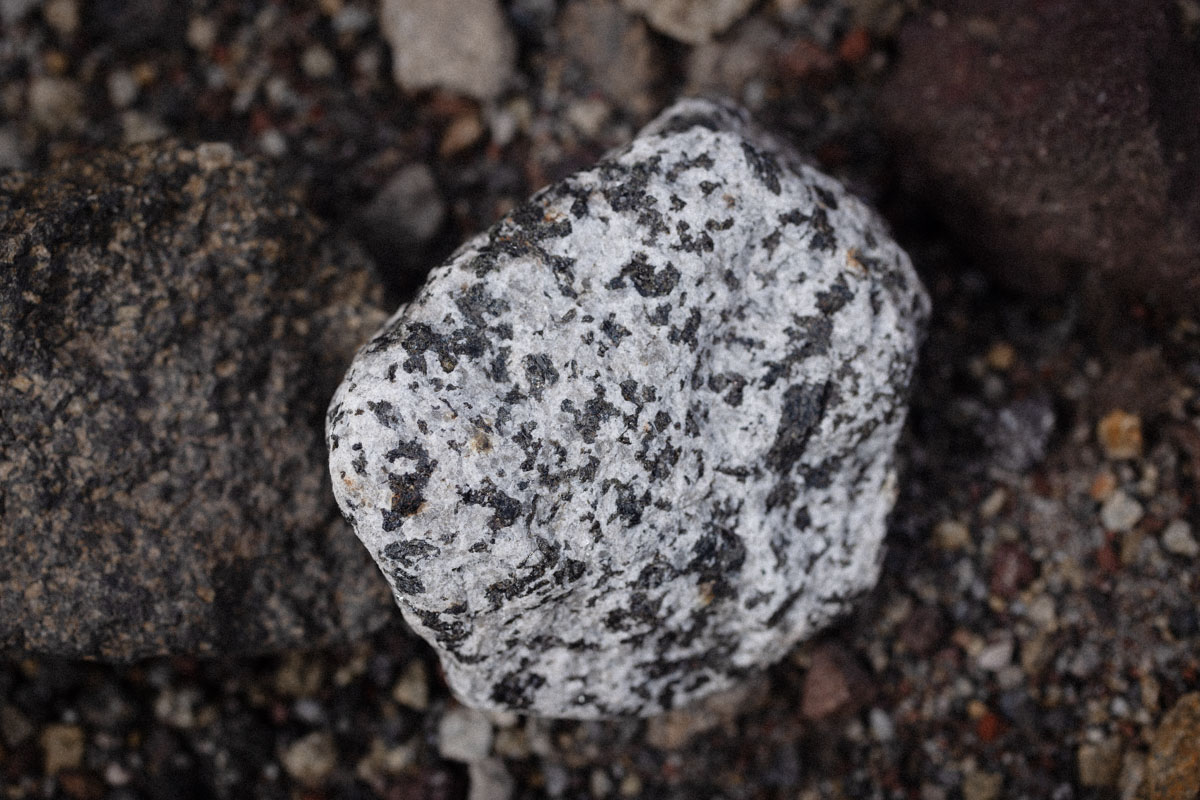
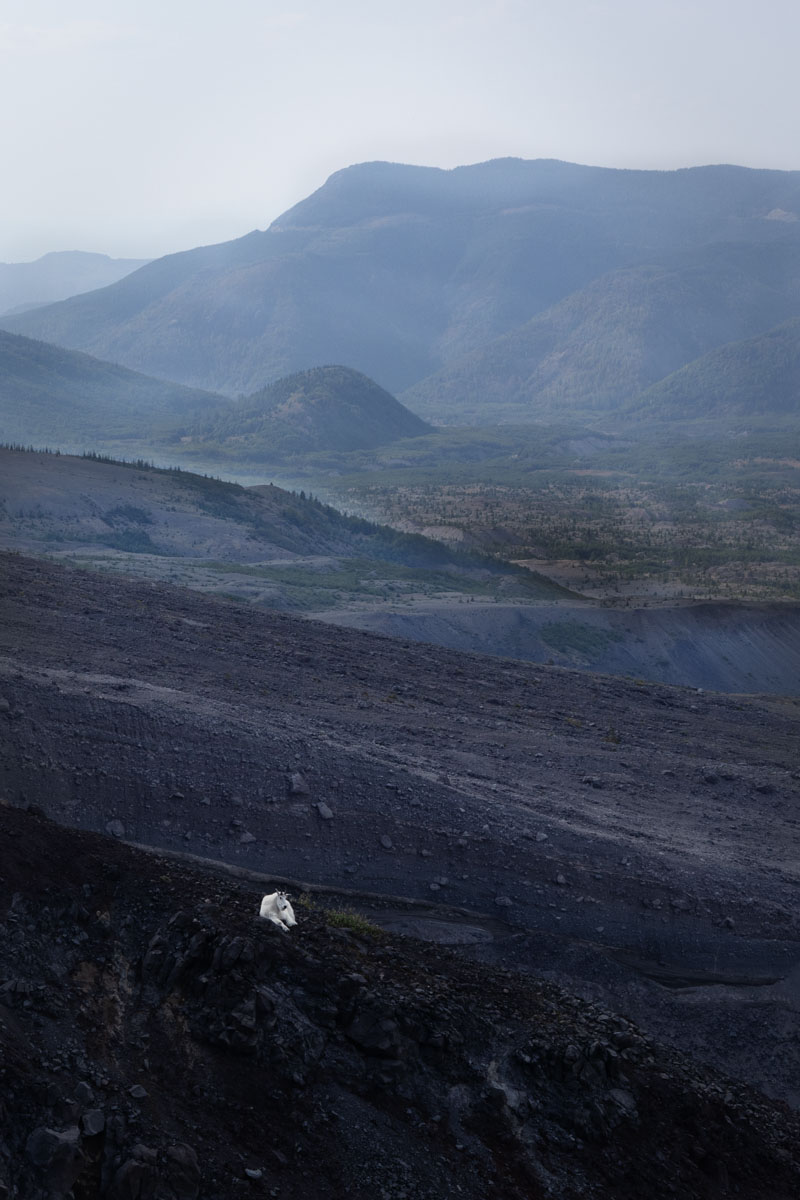
Goat relaxing and watching hikers from a ridge of the volcano.
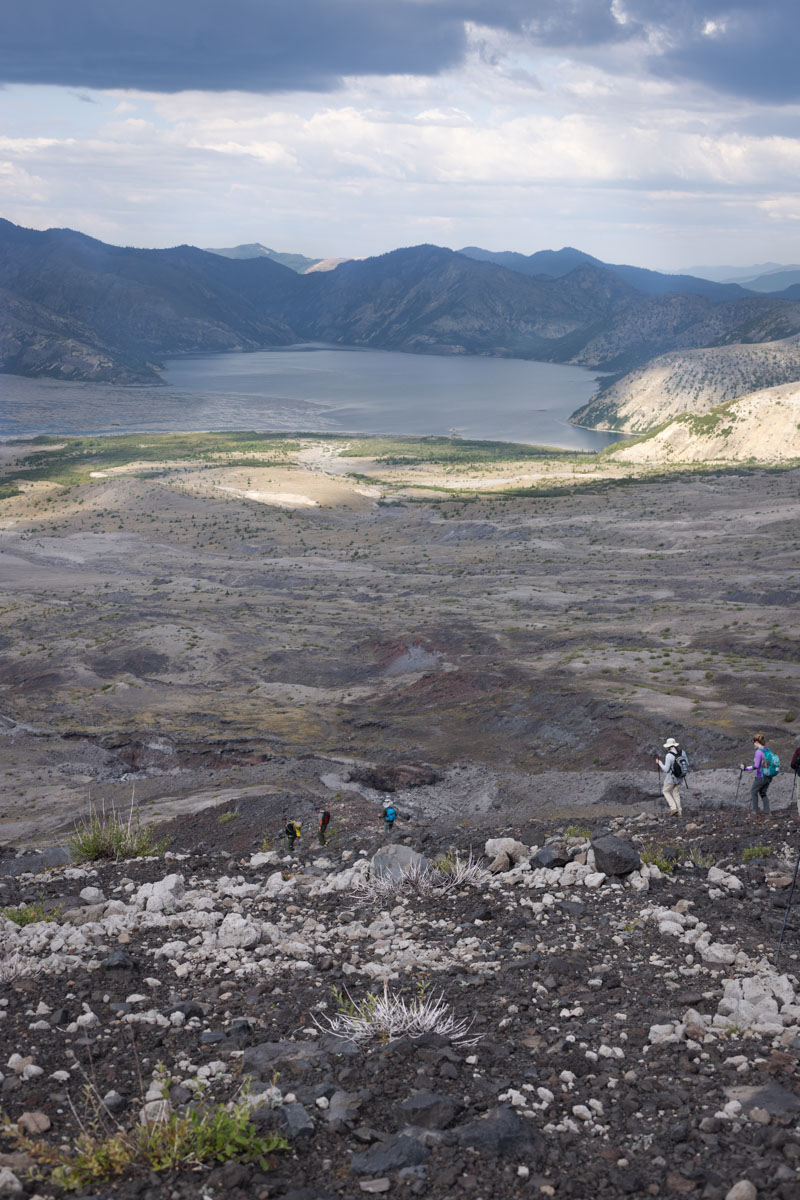
Looking down at Spirit Lake. Many rot-resistant cedar trees that were downed in the 1980 eruption are still floating in Spirit Lake.
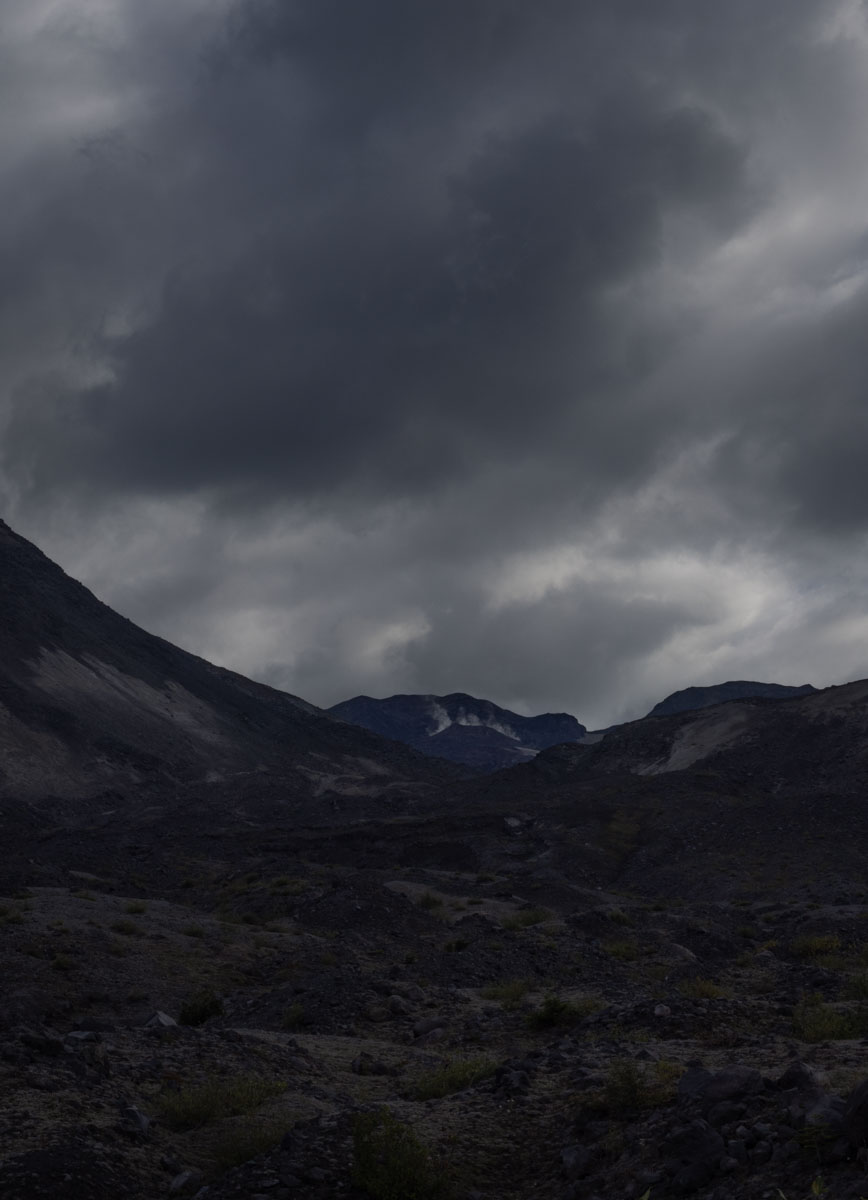
Looking back, you can see the steam rising from deeper into the volcano. It is mostly water.
Such a long slog along the edge of the mountain, and such a relief finally to reach our cars, after more than eight hours. With Dave and Eric still out of sight, Gary hastily arranged for other drivers to take the people who had carpooled with him back to camp so he could go back to help. Veronica drove Gary's F350, with fancy lifting and lowering running boards, back along the precipitous road of loose gravel so she could unlock the gate for the others, and then returned with the truck, not wanting ever to drive such a large vehicle around such tight turns again. I had brought Mather to the trailhead and so was equipped with shelter, food, water, warm clothing, a laptop, and my memory card, and would have been perfectly happy just to work on my photos while I waited. But the Mount St. Helens Institute never leaves anyone alone, so Veronica and Alyssa stayed with me while we waited about another hour.
At last, we saw Dave's bright red MSHI volunteer cap in the distance. I started waving. Then Eric waved his poles in the air. He was still walking. Despite the injury, he made it the entire way!
A triumphant Eric arriving at the trailhead with Gary (left) and Dave (right).
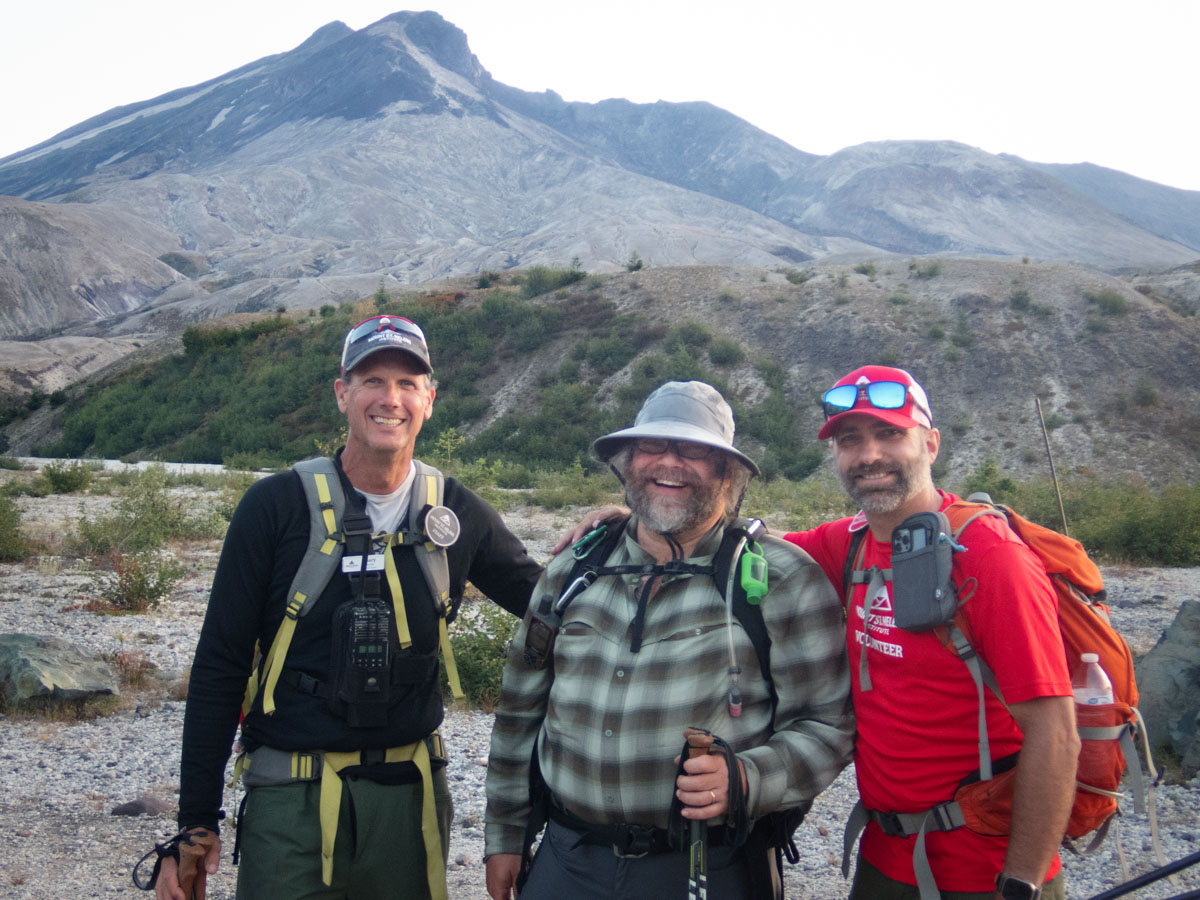
"Through the whole hike," Eric said, "I kept thinking, 'Pain is temporary, but the story is forever.'"
We returned to camp to applause and cheers! Someone called for someone to bring Eric a beer, but he doesn't drink much and just wanted a nice Impossible burger. Salads and veggies were still out, and Chef Matt had the grill ready to quickly cook up Impossible burgers for Eric and regular ones for Gary, Dave, Alyssa, Veronica, and me. I had an IPA on Eric's behalf.
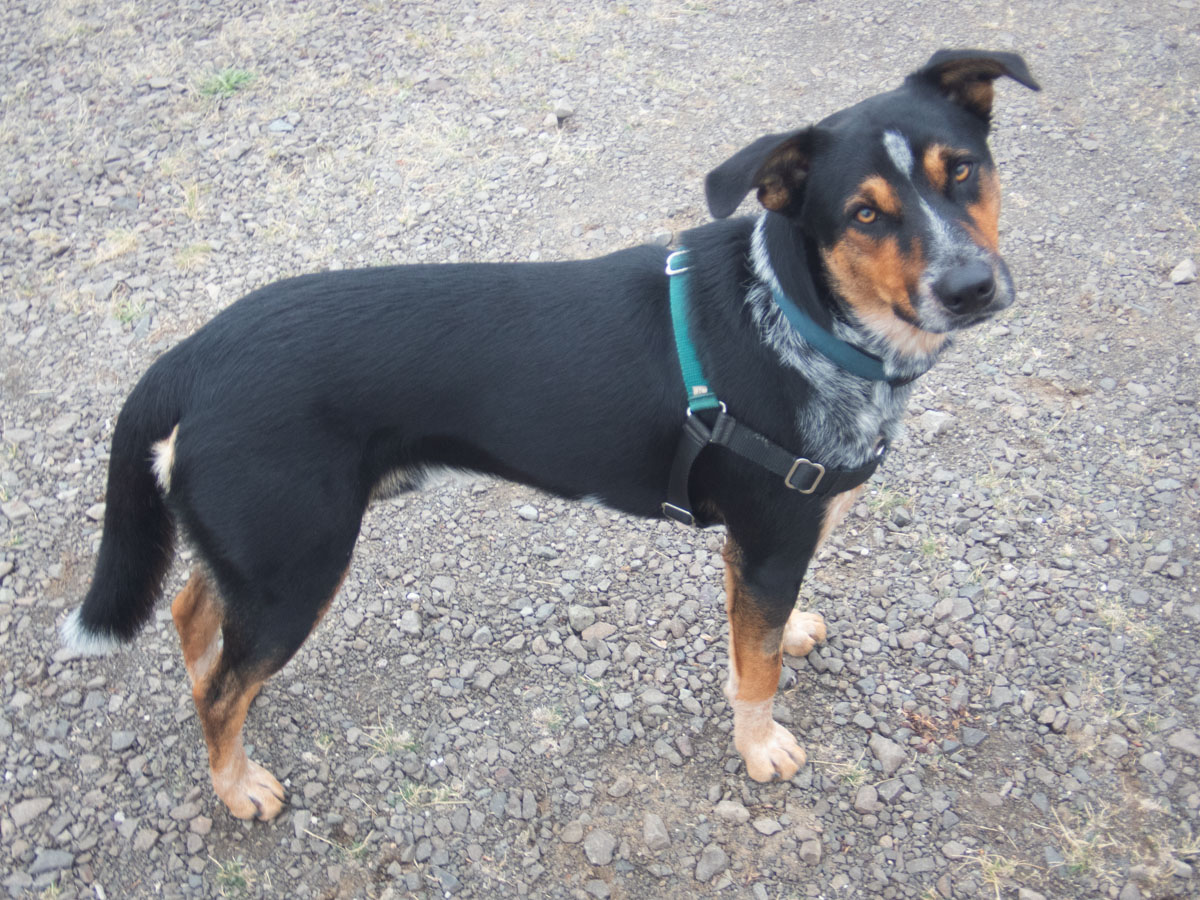
Matt's dog, Early Bird, mugging for Eric.
We sat around the propane campfires under a couple of canopies and recalled our stories of the day. Dave told of how proud he had been of Eric for stubbornly making it through the entire route, step by step. Several others expressed admiration for such stubbornness, until Saynier pointed out that we should instead appreciate Eric's tenacity. We all described the life-altering experience of the wonder of seeing inside the crater.
I don't know when or whether we will ever be able to participate in such an awe-inspiring adventure again, but the Mount St. Helens Institute gave us an unforgettable experience.